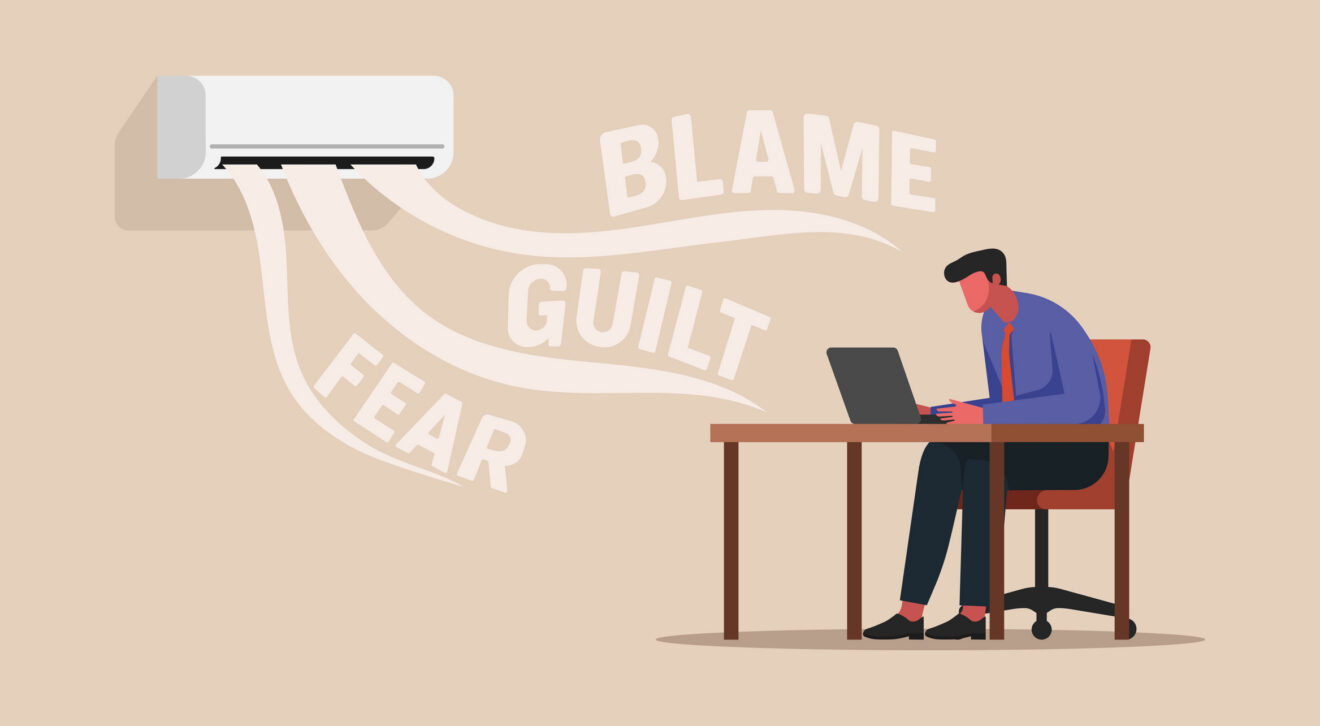
A vice president misses a deadline and spends the week avoiding her team, convinced she is not cut out for the role. A second vice president misses the same deadline, feels sick about the specific decision that caused it, apologizes and fixes the process. Both feel bad about the same failure. Only one of them recovers.
The difference is not willpower or resilience training. It is the difference between shame and guilt, two states neuroscience treats as genuinely separate rather than two words for the same discomfort. Most leadership advice on handling failure does not make that distinction, which may be why so much of it does not work.
Two moral emotions, built for different jobs
Shame and guilt both belong to what researchers classify as self-conscious moral emotions, alongside embarrassment and pride: states that require a sense of self and an internalized awareness of social norms, rather than emotions triggered by an outside stimulus. Within that family, the two split in opposite directions. Shame is the personal one, a global judgment about the self. Guilt is the social one, tied to having broken a norm against another person, and organized around repairing that harm, whether the repair is aimed at the other person or at restoring one’s own sense of having done right.
Guilt can be built in a lab. Shame resists it.
That split shows up in how researchers study these two states. There is a working method for producing guilt on demand: ask someone to write a detailed autobiographical account of wronging another person, and the guilt response shows up reliably enough to study. Shame does not cooperate the same way.
In nearly two decades directing my own research labs studying stress reactivity, I have never attempted a shame-induction paradigm, and would not: the ethical concerns alone have kept it off the table, even as guilt paradigms remain straightforward to run. The published literature reflects the same pattern. A 2025 systematic review of self-conscious emotions research found that standardized, ecologically valid paradigms for eliciting shame in a lab setting are scarce, in part because shame, as the more purely personal of the two moral emotions, requires an internalized sense of self that is difficult to manufacture on command, and in part because deliberately inducing it raises real ethical concerns for researchers.
That difficulty is not shared across all emotions. Sadness and happiness have decades of standardized, validated induction procedures behind them, including normed film-clip catalogs and self-referential “Velten” statements. Shame and guilt have no real equivalent, because they depend on an internalized sense of self rather than an external stimulus.
The brain treats them differently, too
A voxel-based meta-analysis pooling 17 shame and embarrassment studies with 17 guilt studies found that the two states share a substrate: both activate the left anterior insula, tied to emotional awareness and arousal. But each also engages its own territory. Guilt recruits areas tied to social cognition. Shame and embarrassment recruit brain regions associated with social pain and behavioral inhibition.
My own read, offered as a working hypothesis rather than something the literature has directly confirmed, is that shame leans closer to sympathetic nervous system activation, consistent with its social-pain and behavioral-inhibition signature, while guilt leans closer to default mode network engagement, the network most tied to self-referential and social thought. The caveat matters: because shame is so difficult to induce experimentally, most of what we understand about either state comes from inference, not direct confirmation.
One methodological point is worth noting. Much of this neuroimaging work asks participants to recall or imagine a past shame episode in a scanner, not live through one in real time. Workplace shame is rarely imagined. It repeats itself, is often witnessed by colleagues and can follow a person from one meeting to the next, which may be why it becomes entrenched rather than a passing state.
That distinction plays out in behavior. Because guilt is organized around a norm broken against someone else, research on moral emotions consistently finds it more strongly linked to reparative, prosocial action than shame is: guilt tends to make people want to apologize and fix the specific thing they got wrong. Shame, with no other party built into its structure, tends to make people want to disappear, withdraw from those they let down, and avoid the situation that caused it. Psychologists have a name for this split: guilt behaves like an approach emotion, pulling a person toward the mess they made. Shame behaves like a withdrawal emotion, pulling a person away from it.
What this means when a leader gives feedback
Most feedback lands as one state or the other, whether or not the person giving it intends it to. “That report was late, and it cost us the client meeting” is guilt-shaped: specific, tied to an action against the team, and correctable. “You’re not someone I can rely on” is shame-shaped: global and identity-level, and, based on the research above, something the recipient’s nervous system may not even be well-equipped to metabolize and act on in the way it can with guilt.
The same failure can be delivered either way. A missed deadline can become “you dropped the ball on this handoff, and here’s what needs to change,” or “I need to know if I can count on you.” The first names a bounded, repairable violation. The second reaches for the whole person, and tends to get a defensive or withdrawn response rather than a corrective one. That reaction has a specific address in the brain, and it is not the one most casual coverage of stress and feedback reaches for. The circuitry behind it leans more on the dorsal anterior cingulate cortex and thalamus, which are tied to social pain, and the premotor cortex, which is tied to behavioral inhibition, than on the amygdala or the prefrontal cortex that popular treatments default to.
This is also why telling someone in a state of shame to think positively or be more confident often fails. Positive self-talk changes a belief. Shame is not primarily a belief problem; it functions more like a state in which the brain’s self-referential and social-threat systems are already running, closer to a felt sense of exposure than an argument that can be reasoned with. Guilt, tied to a specific violation, is far more available to that kind of reframing because there is an actual, bounded thing to repair.
The practical implication is not to avoid hard feedback. It is to keep feedback within the territory of guilt: the decision, the action, the person it affected, rather than sliding into a verdict about the person receiving it. One approach produces a team member who apologizes, adjusts and stays engaged. The other produces one who withdraws, and whose nervous system may not have a clear route back from where the feedback sent it.
Opinions expressed by SmartBrief contributors are their own.
____________________________________
Take advantage of SmartBrief’s FREE email newsletters on leadership and business transformation, among the company’s more than 250 industry-focused newsletters.