
After discussing productive AI usage with industry leaders from around the world, I’m convinced that we are still working out what it means to use AI properly. I’m also convinced that as we engage in useful dialogue with AI, we can move away from what I call the “CAP” (Copy and Paste) model, and start applying our domain knowledge to situations. This is where a vital nexus is created, and we can effectively reach a form – albeit analog – of ever-elusive Artificial General Intelligence (AGI). This starts by first recognizing how to properly interact with AI. It then continues by analyzing your choices, processes and workflows to see what AI can automate and do better than you. It also involves making choices that allow you to make the best immediate contribution in any situation. Let me explain.
Moving towards authentic intelligence: The four AI interaction modalities
By automating tasks and using AI to create efficiencies, we become more human. That’s what I mean by “authentic.” Proper use of AI frees up time and creates a clearing that allows us to become more thoughtful and less distracted. But to do that, we need to use Artificial Intelligence properly. I learned this lesson from interacting with professionals from AWS and students in Africa during a 24-hour “hackathon” run by a student-focused company called Geekulcha. First, I have a question to ask you, based on what I learned there:
On a scale of 1-5 (with 5 being the best), how would you rate your AI fluency? Before you answer, consider the four ways you can interact with AI.
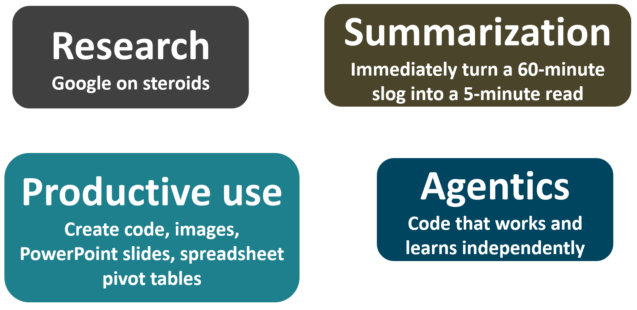
How much do you use all four of these ways of interacting with AI? To achieve Authentic Intelligence, I submit to you that it’s vital to become conversant in all four areas. I’ve come to this conclusion after talking with workers in many industry sectors, from the pure “tech sector” (e.g., AWS) to finance, healthcare and government.
The industry needs “systems thinkers” and “process thinkers.” Well, AI frees up time for people to become just those things. It allows us to move forward with confidence and put our individual contributions forward in the best possible way.

Creating context: Prompting remains “a thing”
Humans are fantastic context creators. AI, right now, is a fantastic pattern matching machines. Put them together, and you’ve got something.
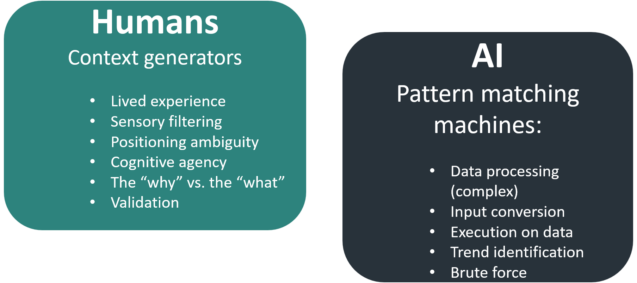
Check out the graphic below:
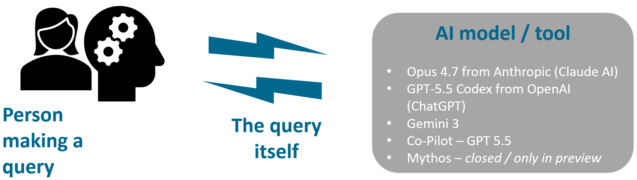
Which part of the above dialogue is the most important? I would argue it’s either the person making the query or the actual prompt itself. I lean more towards the person.
To achieve authentic intelligence, I would argue that your prompt needs to provide adequate context. This involves providing a goal, as well as detailed contexts and constraints. Earlier this year, I heard a leader from the United States Department of War tell an audience that prompting is dead. Prompting, he said, was no longer important. I couldn’t believe my ears.
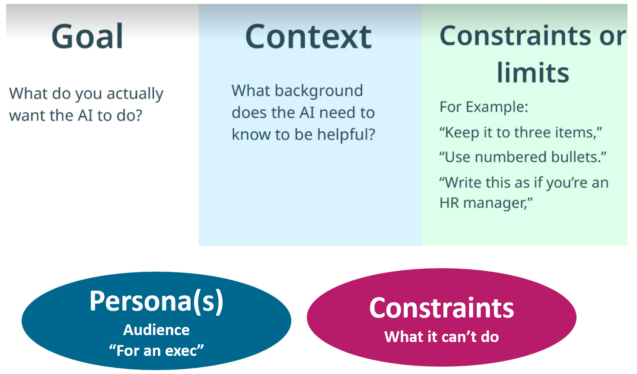
It was tragic to see people in the room nod in agreement to such nonsense. Right now, if we don’t provide context through well-written prompts, then AI – and you – will be doomed to wander in an inauthentic haze.
Applied AI: What is your tone stack?
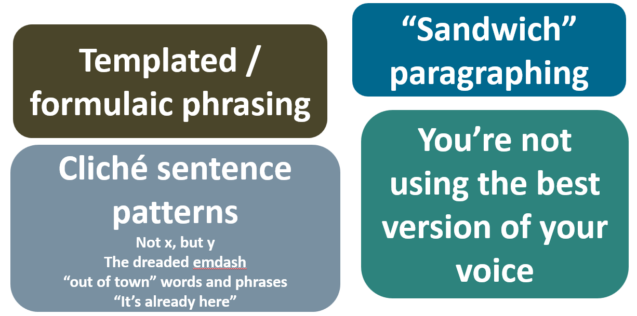
Let me provide a practical example. Most workers need to write well in order to keep their jobs. Good writing involves myriad factors, including adopting a useful tone. This is one area where you can achieve authentic AI. But, we often cede our human ability to create the proper tone to AI. That’s a mistake. Guard against losing your voice and authenticity to an improper AI dialogue. Avoiding that involves choosing the right tools and techniques.

These techniques constitute your “tone stack.”
Over the years, I’ve enjoyed playing guitar in quite a few bands. Most electric guitar players are tone hounds; they use equipment to get a unique sound. You can see my particular “tone stack” (picture to the left).
Well, I’ve found that using AI productively involves choices, just like how a guitar player makes choices. Some guitar players I know allow their effects and amplifiers to run away with them; they forget that tone starts with your mental choices and your fingers, more than with any device.
Well, the same is with using AI: If you don’t choose your tone stack elements well as you write and create, you’ll end up drifting away from Authentic Intelligence, and into the AI slop swamp.
Remaining authentic
As you create documents, focus on providing context while also taking the writing reins and iterating your way toward authenticity (Think: Specifics, Context, Action Verbs and Iteration).
You might be thinking that all of this seems like a lot more work than what was originally promised. Well, it is: Because when it comes to adding instant value, there really is no “easy button.” It requires work on your part. Otherwise, you’re just a slop purveyor.
Let’s get technical for a moment
Let’s take a different tack here before this article devolves further into a composition-and-rhetoric article. From a technical perspective, Authentic Intelligence means that you can use AI to create a human context almost immediately. The cybersecurity profession has settled on a value trifecta: First, it’s where you use AI to protect AI itself. Second, you use AI to make traditional operations more efficient. Third, you use AI to speed up governance without skipping too many steps.
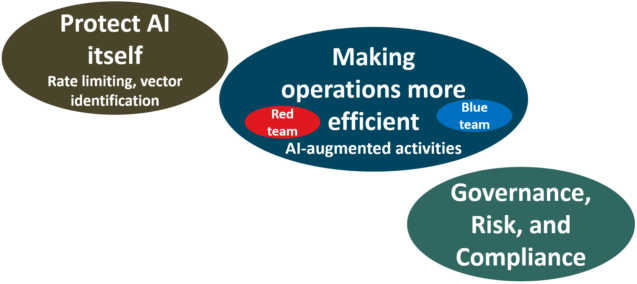
This trifecta allows cybersecurity blue teamers (defenders), for example, to transition from “eyes on glass” shovelware screen scrapers to more useful communicators and context creators. Cybersecurity SOC analysts aren’t going away. But those operating with authentic intelligence are able to communicate and contextualize. In my work at CompTIA, I’ve noticed that authentic workers can quickly interact with fellow workers during cybersecurity incidents to create accurate incident response narratives. This is now expected. Yet, it wouldn’t be possible without using AI to summarize information efficiently.
Security analysts are being asked to distill massive amounts of data into actionable playbooks and recommendations in record time. That just can’t be done at scale and in useful amounts without AI. But companies are also finding that the wrong application of AI can’t create actionable information. So, it’s not a question of putting the “human in the loop,” but what I call the “prepositioning of AI.” We need to negotiate where humans and AI exist in, on and over the loop. I promise to try to make the article clear and fun.
The prepositioning of AI and your authenticity
It’s really not possible to engage in authentic intelligence all of the time. And, there’s really no single definition of what it means to be authentic in the use of AI. It’s a negotiation; your relationship with AI will remain contingent and in the moment.
From my experience, we’ll be constantly negotiating our place and the place of AI in a continual dialogue. This means we’ll see fewer “human in the loop” discussions and more “prepositioning” of AI. If you remember from your English grammar, a preposition is any word that shows direction, location, time or placement. They include words such as “over,” “on,” “in,” “out” and “under.” Organizations and workers are discovering where to place AI, and where to place the human.
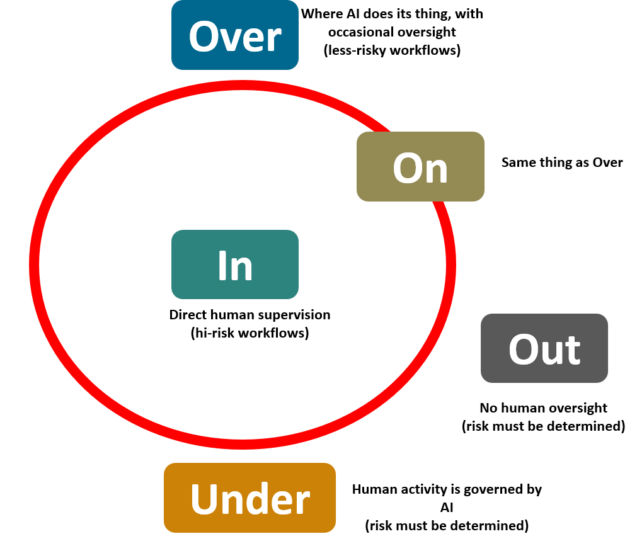
Your ability to achieve Authentic Intelligence involves your ability to determine the best place where you’ll contribute to a given situation. For example, a person I know who works at a large oil company has spent years building and maintaining Operational Technology (OT) systems. They are used to help pump oil out of the North Sea. He told me that he’s now using AI to create alerting scripts and enhanced dashboards so that workers have better visuals.
He basically told me that it has taken him some time to divine where AI could help him. But after a while, he determined that AI saved him time and allowed him to finally get ahead of the game. He realized that he had to invest time, and then there would be a good payoff. To me, this is Authentic Intelligence, because he realized there’s no free lunch. It requires work to get things started. Second, it’s authentic because he combined his experience and negotiated exactly how AI could help him improve incident response and observability. That’s pretty cool. It’s also quite authentic and intelligent. It’s Authentic Intelligence – something most anyone can achieve with a bit of work and due diligence.