
When it comes to infrastructure management, the set of processes, tools and approaches under the “DevOps” banner constitutes the hidden heartbeat of modern IT. That fact struck me recently as I viewed Sydney Australia’s infrastructure, including the Opera House and Sydney Harbour Bridge.
I was struck by how this infrastructure just plain works. I couldn’t help but think of some of the discussions I was having with industry leaders there. They emphasized to me that organizations can’t have continuous integration and continuous delivery in a system of systems that is patched together.
Organizations, I was told, are transforming themselves to establish a more coherent technical foundation. That foundation is DevOps.
Yet, modern organizations are attempting to deploy AI, improve cybersecurity, accelerate software delivery and satisfy increasingly complex compliance requirements. Yet many are doing so on top of fragile, manually managed infrastructures that were never designed for today’s pace of change.
Why DevOps?
Automation has become a foundational capability for organizations seeking consistency, scalability and resilience. Business leaders are increasingly impatient with bottlenecks and are seeking more precision. They require an intentional approach to IT.
Automation can help:
- Set a foundation that makes it easier to map to regulations.
- Create operational stability.
- Rationalize systems: It allows you to think about how systems behave rather than getting lost in details.
With DevOps, you can avoid having the technical tail wag the organizational dog.
Delivering instant value
During a conversation I had with an IT manager from National Australia Bank, she told me that she thinks of her workers as “instant contributors.” That’s a sentiment I’ve heard quite a bit lately in various sectors, from finance, healthcare and manufacturing. Having a strong DevOps foundation enables organizations to create an environment where technical contributions from teams and individuals are realized more quickly. Having specific DevOps skills can also help you stand out as a worker with unique skills.

Benefits include:
- Establishing a rational architecture: You can establish processes that map more closely to the business processes that create value for a company.
- Better data management: Once you have established a DevOps approach, data management suddenly becomes easier. I can’t tell how many times I’ve heard IT leaders lament that they can’t establish a “single source of truth” when it comes to organizational data. One reason that it remains a problem is that they have a 20th Century technical foundation that relies on patched-together scripts and fixes, rather than automated systems that enable true version management for their cloud systems, AI platforms and codebases.
- “Systems on systems thinking:” Building an architecture, and focusing on “system of systems” type of thinking, rather than tactical. Build a blueprint.
- Establishing a foundation for AI: Organizations rushing into AI often discover that model quality is not their biggest challenge. Their biggest challenge is operational maturity. Without disciplined automation, configuration management, version control and observability, AI initiatives struggle to scale beyond isolated pilots.
Process improvement
Implementing DevOps involves more than using Kubernetes or any specific Infrastructure as Code (IaC) tool. It requires individuals to have sufficient curiosity to learn about how organizations address their customer base and generate value. I once spoke with a team of cybersecurity analysts in Melbourne. One of the team members wistfully asked me, “I wonder if my boss knows how really I do things, these days?” She then told me about how the AI-enabled systems she is using leveraged continuous delivery methodologies to improve incident response. She told me further that she had identified key vulnerability management workflows that sped up processes. She told me that it was all about fixing workflows.
Is this achievable for all organizations?
Few professions are as fashion-conscious as IT and cybersecurity. However, I’m convinced that a DevOps approach to automation is now available to the vast majority of organizations. It’s part of what I call the democratization of IT: Larger organizations have always had the luxury of big-time automation and building foundations. But that was a very small percentage of companies. It’s now available to more of us.
And, that’s significant. We can now use technology that used to be the purview of the elite. That’s one of the wonderful things about technology.
Living in the “three time zones”
Some time ago, I spoke with Andy Flatt, the CIO of the National HealthCare Corporation (NHC), which has revenue of roughly $1.5 billion. He told me that without DevOps, he has had to live in three time zones at once. At first, I didn’t understand what he was talking about. He then told me that the three time zones were the past, the present and the future.
He told me that he often has to deal with undocumented decisions that were made 5 years ago. He also has to honor the present, meaning he has to get things done. Finally, he has to consider what’s going to happen in the future: He needs to know where things are going, so that he can future-proof what he does as much as possible.
Those are the three time zones.
Once he focused on getting his workers up to speed on automation, however, he found he could stop his time-traveling ways. Instead of having to deal with symptoms, read the tea leaves and worry about the ghost of IT past coming to haunt him, he could start thinking proactively about future implementations.
Benefits of a strong foundation in automation
Once you have your DevOps and CI/CD ducks in a row, you can then move beyond mere monitoring. You can enter the world of observability. This is where you have the ability to more accurately understand the overall health of your systems by thoroughly analyzing the following:
- Metrics
- Logs
- Traces
Once you triangulate these three elements, you can get beyond the surface of situations. Traditional monitoring only tells you what is broken (e.g., the server just died). Observability helps you understand more completely why a system broke. You can become a true systems whisperer.
But, you can’t get true observability going until you first have your DevOps processes put in place.
This allows you to avoid a magic world view of IT and become a methodical, deliberate creator of systems. To put this in terms of someone who knows systems administration, with DevOps, you’ve moved from using a bunch of commands to managing the state of your system.
It’s not ignoring the details; it’s setting up systems so that the details matter. IaC provides the context, as it were, for the individual code and computers to be part of a syntax. And that syntax helps create an organization that can do business better by leveraging technology.
I don’t see this as replacing workers; I see it getting workers closer to the heart of the organization’s relevance and ability to fulfill its goals.
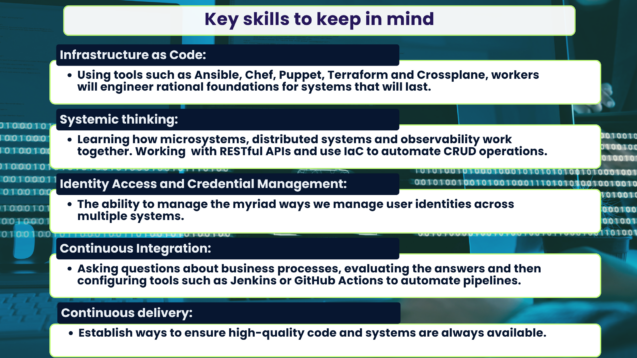
The organizations that thrive over the next decade won’t simply adopt more automation tools. They’ll build operational foundations that enable automation, AI, observability and continuous improvement to work together. DevOps isn’t merely a technical practice anymore. It’s becoming a prerequisite for organizational agility.
Once teams have their DevOps foundational skills, they can leverage many tools. This includes AI, while spending less time typing and more time improving architectures and efficiencies.
I was once told by a good CIO that he got paid well, not because he knew things, but because he did things. Things have changed: Now, leaders and workers are considered relevant because they have created conditions for good technical and solid business decisions. That’s the promise of automation today.
If you like these insights on technology, sign up for the CompTIA SmartBrief, a daily look at the top news and trends in IT.
But wait, there’s more!
James was a recent guest on
“The Mostly AI SmartPod”
Watch here.