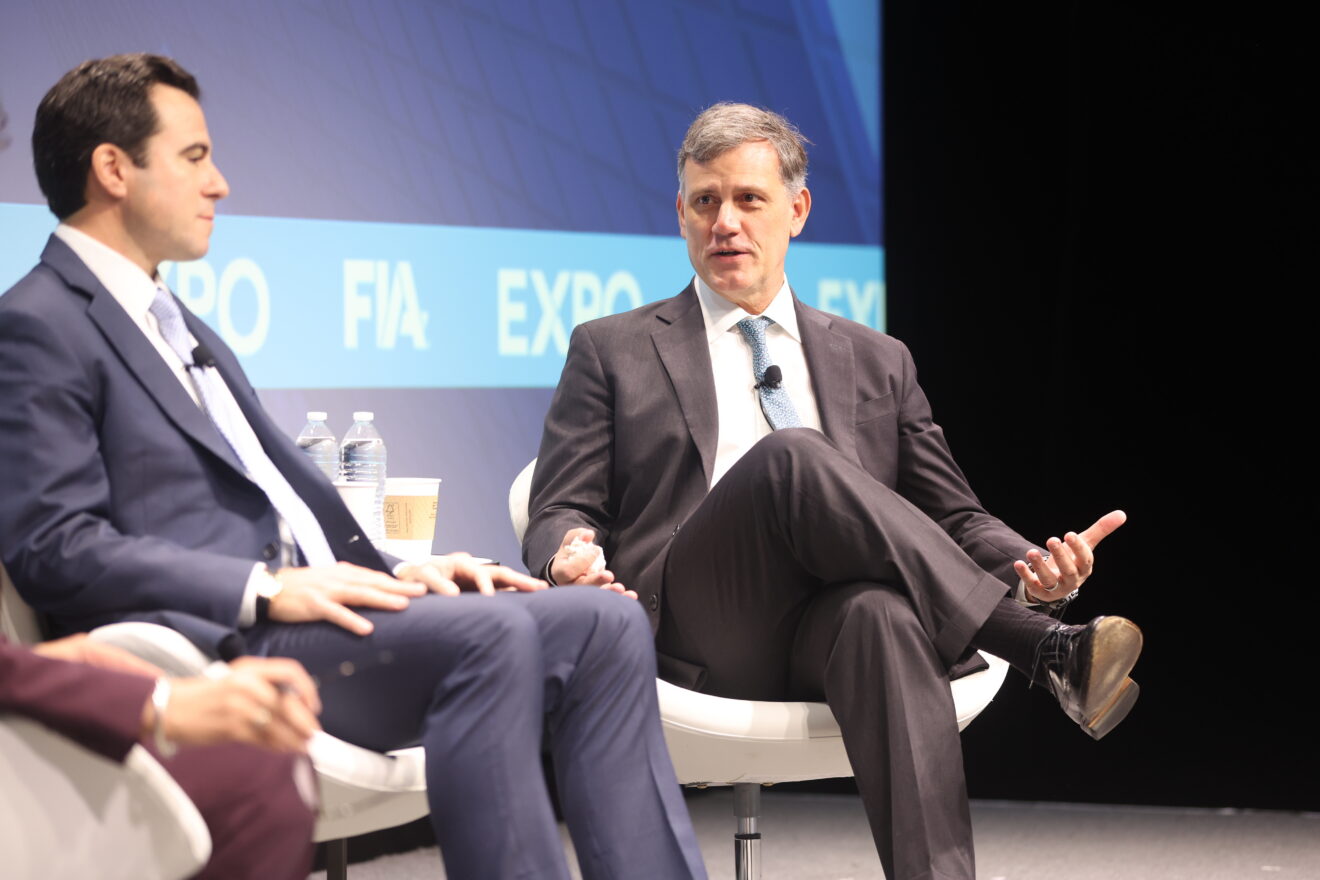
Senior officials from the Commodity Futures Trading Commission and the Securities and Exchange Commission said the agencies are working more closely than in past harmonization efforts, even as prediction markets, perpetual futures, DeFi and round-the-clock trading raise new jurisdictional questions.
Speaking at FIA’s Futures & Options Expo, DJ Hennes, director of the CFTC’s Market Participants Division, and Jamie Selway, director of the SEC’s Division of Trading and Markets, said the difference this time is connectivity below the chairman level. The session, “The Regulators Speak: CFTC & SEC on What’s Next,” was moderated by Jackie Mesa, FIA’s COO and senior vice president of global policy.
Agency Coordination
- Selway said the agencies’ chairs meet weekly and that he and Hennes talk multiple times a week, with several joint workstreams underway. Hennes framed the effort as a matter of necessity. “In every other country, this is one agency. It’s just historical here. It’s two, and so it’s incumbent on us to be as closely coordinated as possible,” he said, adding there’s an effort to make that cooperation lasting and durable.
- Joint meetings with registrants have addressed products including security futures and a package of Treasury futures and spot Treasurys.
- Shared priorities include market surveillance, data interoperability, exams and aligned rules. Regulators are considering joint rulemakings on swap data reporting and portfolio margining.
Products and jurisdiction
- Selway noted the agencies have chosen to let products with similar economics proceed through different regulatory channels, and that market arbitrage should keep prices aligned. He said the SEC is mindful of venue shopping and would try to close any gap that gave one venue an unfair regulatory advantage.
- The officials said the agencies are considering joint rulemakings on swap data reporting and portfolio margining, and have requested comment on definitions, portfolio margining and trade reporting.
- Hennes said current rules require 128 data fields for each swap or security-based swap, a number that grows to more than 200 at swap data repositories. He suggested starting with the roughly 30 to 40 fields in a trade confirmation, then adding more for transparency and emergencies.
DeFi and digital assets
- Hennes said the CFTC is weighing two paths: on-chain protocols registering directly, or registered firms using them as technology providers while keeping their compliance obligations. “How decentralized is it really? It’s easy to slap that label on it,” he said.
- Hennes added that closing off offshore access via VPNs is a mandatory part of any approach.
- Selway said genuinely peer-to-peer trading may not need regulation, but much of what is called DeFi involves intermediaries. “We’re technologically neutral. It doesn’t matter if it’s on chain or off chain, but if there’s an intermediary and they’re doing a regulated function, they’re going to be regulated,” he said.
- Selway described the SEC’s five-year innovation exemption for tokenized-security venues as temporary relief.
- Both said legislation would help clarify digital-asset definitions but is not required for their work to continue.
Trading around the clock
- Selway said the SEC expects market data infrastructure and some exchanges to move to 23-by-5 trading on Dec. 6, with the 8-9 p.m. Eastern hour reserved for corporate actions. He said 24-by-7 equities trading could follow.
- Selway flagged that there is no banking system or Fedwire over the weekend, though stablecoins look promising. “It’s a 56-hour gap from 8 p.m. Friday to 4 in the morning Monday. So it’s substantial. It’s a real risk,” he said.
- Selway said demand is mostly retail and Asia-Pacific. “Just because you can, doesn’t mean you should,” he said, adding that institutions are not obligated to use off-hours markets.
- Hennes said the CFTC is assessing extended hours asset class by asset class, with crypto a natural fit but agriculture markets “not ready yet.”
- Weekend margining, settlement and manipulation risk remain open questions.
Open challenges and what’s next
- The officials said the agencies are still reviewing conflicts of interest in vertically integrated structures that combine exchanges, clearing and brokerage.
- They are considering consistent rules, coordinated exams and what Selway called “alternative compliance.”
- Mesa noted that the session took place the morning after Election Day and asked whether the agenda could withstand a political shift. Selway said the views expressed were his and Hennes’s alone, not the commissions’, and argued the work is largely technical and apolitical. “No successful politician wants to repeal success,” he said.