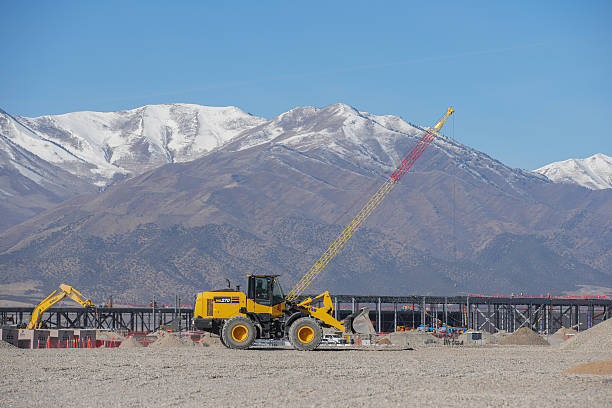
If the Associated General Contractors of America’s annual outlook survey is any indication, the construction industry’s hottest market will carry its momentum throughout 2026. For builders and asset investors looking for certainty in an otherwise uncertain business environment, data centers and power facilities are a clear north star in an industry that headed into the year with not nearly as many strong markets to capitalize.
This year, five market segments show negative expectations, up from just two last year, according to the survey. The average net reading across all 17 categories has dropped, but remains moderately positive at 9%.
By the numbers
On top of abnormal market weakness, contractors are also continuing to deal with the industry’s ongoing workforce challenges, with economic slowdown emerging as the top concern (62% of firms surveyed by AGC), marking a major shift from last year. Sixty three percent of firms responding to the survey reported having a project postponed, scaled back or canceled in the past six months. Thirty-seven percent cite funding uncertainty and 34% cite unavailable or expensive financing as major contributors to reduced project scope. Materials costs remain a concern for 53% of firms.
Roughly seven out of ten firms reported being affected by tariffs. Forty percent of respondents said they responded to tariff pressure by raising bid prices, whereas 35% passed the lion’s share of tariff costs to project owners. Supply chain issues seem to have moderated overall, with 45% of firms reporting no issues, but electrical equipment and HVAC systems remain problematic. The survey also suggests lead times are becoming increasingly tied to compliance requirements rather than broad material shortages.
Data centers had the highest net reading (57%) and posted the only double-digit gain from last year’s AGC survey. Power projects remain very strong, with a 34% net reading. Health care facilities show moderate optimism, particularly non-hospital facilities like clinics and medical labs. Water/sewer projects and manufacturing maintain positive but more modest expectations. The most negative outlooks are for retail construction (-18% net reading), private offices (-14% despite an increased trend toward return-to-office policies) and lodging (-7%).
Net readings for higher education (-5%) and K-12 schools (-1%) both turned negative for the first time since 2021.
Unsurprisingly, the survey once again offered some bleak context about industry’s chronic labor struggle, with just 63% of firms planning to add headcount this year; down from 69% last year. More than 80% of respondents reported difficulty finding qualified workers. One-third of firms said they have been affected by immigration enforcement actions.
Industry reports from last year indicate 450,000 construction jobs remain unfilled across America, revealing a significant skills gap that training programs alone will not be able to close in the near future. Immigration enforcement raids, including some that have allegedly occurred without warrants, have exacerbated the problem. And the impact cascades through project schedules and profit margins in ways that labor reports don’t capture.
Firms are throwing money at the problem, with 40% of firms increasing base pay in 2025 by more than they did in 2024. But you can’t pay someone more if they don’t exist. And right now, the skilled trades aren’t attracting new entrants at anywhere near the rate needed.
Regional responses vary. In Kansas, Kyle Van Slyke, chief operating officer at Musselman & Hall Contractors, sees movement. State and municipal leaders finally recognize the workforce crisis. But recognition and action are different things.
“I think finally, both state, municipalities, all the leadership is seeing the need, and they’re starting to rally around helping,” Van Slyke said during AGC’s post-survey media briefing. “But organizing everyone into a cohesive, aligned way to do something about it is still probably the biggest struggle.”
In Tennessee, Arch Willingham IV, president of T.U. Parks Construction, took matters into his own hands. He invested $10 million in a Construction Career Center that graduates 225 qualified workers annually. Every single one is placed into a job before they graduate. The initiative won AGC’s Chapter of the Year award.
Traditional hiring methods are still the default. Ask your superintendent if he knows anybody. Anybody at church. Anybody with a pulse who can show up from 7:30 to 4.
“That’s not a great way to staff what our industry requires,” Willingham said. “It’s a dangerous industry. It requires a lot of technical efficiency. That’s a terrible way to vet people.”
Investors like HVAC-centric data center projects
A recent article by law firm Morgan Lewis suggested growing demand for data centers is transforming HVAC from a facility cost to a strategic investment. Colin Mangham, chief experience officer at U.S. Green Building Council California (USGBC-CA), agrees, noting that “if cooling fails, everything fails.”
“When a lender or insurer evaluates a data center project, they’re not thinking about green credentials,” Mangham wrote in an email to SmartBrief. “They’re thinking about what breaks, what costs money to operate, and what could trigger total failure. Cooling is the answer to all three questions.”
At an investor level, the ability to model energy intensity, uptime and operating costs plays a big role in de-risking data center projects. And cooling is one of the biggest operational expense drivers in these facilities. That’s not new information, Mangham says, but what is shifting is how contractors talk about it because the financial case is straightforward. Cutting energy use, water use and peak demand trickle down to the bottom line.
“That’s not a sustainability pitch. That’s finance,” Mangham says.
For contractors and subs, this represents a major opportunity if they reframe their pitch. Mangham suggests builders stop leading with “green HVAC” and instead focus on lower utility bills, higher reliability, easier maintenance and protection against grid volatility.
“Contractors who get that and lead with financial performance instead of green rhetoric will be well positioned,” Mangham says.
He believes the firms that will thrive are those that can back up performance claims with actual data in the form of commissioning reports, controls expertise and real utility numbers from actual buildings instead of pilot projects.
He hedges all of this, though, by noting that the market for data centers is only as strong as the “social permission” that comes with building them. And that permission is only granted if AI is delivering on its promise of greater productivity and contributions to bottom-line savings.
Data centers can also present a placement problem. As Mangham points out, you can’t put them in dense urban areas. They belong in rural places where land is cheap and power is abundant. That’s great for a small town’s tax base in year one, but it does little to assuage fears of short-term boom-and-bust cycles. The construction industry should be cautious about celebrating too loudly, Mangham says. Data centers will get built because the backlog exists. But if AI productivity claims keep disappointing, the growth projections everyone’s banking on could contract quickly.
AI on the job site, or just replacing Google?
The construction industry has the unique distinction of being able to leverage AI while building the infrastructure and data centers that facilitate AI. On paper, it appears contractors are becoming more open to AI tools and are poised to make bigger investments in it. A little more than three-fifths of respondents to AGC’s survey said their firms use AI or plan to increase investments in it, up from 44% in last year’s survey. The survey noted 45% of firms deploy AI for office and administrative functions, 23% use it for estimating and one-fifth apply it to design or preconstruction. Another 16% said they’re using AI for recruitment, training or other related HR work.
But while the survey numbers are promising and there is a growing number of case studies to demystify site-level AI, Mangham and another leader in the construction AI space offer somewhat sobering perspectives on where the industry really stands with the technology.
Patrick Murphy, founder and CEO of Togal.AI and co-founder of CodeComply.AI, is noticeably careful about framing the current moment in the AI revolution. Murphy recently posted a video to LinkedIn assuring people who feel they’ve already missed the boat on AI that there’s still plenty of time to hop aboard and that the gap between what AI could do and what it’s actually doing is vast.
“We’re still in the very early days of this AI era, and the innovation is going to continue compounding,” Murphy said in an interview with SmartBrief. “The speed of AI improvement is still small in comparison to what’s going to happen in the next five to 10 years.”
Across myriad industries, organizations are using AI for basic search functions that essentially act in place of Google, Murphy says. Construction applications, such as AI agents that handle takeoffs, proposals, scoping and value engineering, are still mostly theoretical, he adds. A recent Wall Street Journal article outlining the industry’s optimism toward agentic AI might suggest otherwise, though.
There’s confusion between what AI can do and what construction actually needs it to do, Murphy says. He spends a lot of time clarifying the distinction because the industry has a long way to go in terms of sharing information.
“Think of something as simple as a takeoff on any given job,” Murphy said. “You could have 100 plus people doing the exact same takeoff and nobody shares it.”
Policy paralysis and the green building dilemma
Mangham articulates a critical challenge facing the green building and renewable energy sectors: Perfectionism in policy creates paralysis in execution. There’s never a perfect time to act, he notes.
“Shipping beats perfection,” Mangham says.
The renewable energy industry faces real incentive cliffs. Tax credits expire. Administrations change. Policy environments shift. Yet waiting for perfect policy clarity guarantees missing opportunities entirely.
The solution, he believes, is to de-risk projects through technology adoption and small-scale pilots. Rather than betting corporate strategy on policy continuity, companies can pilot new technologies in individual buildings, prove performance, then scale. This approach acknowledges policy uncertainty while maintaining forward momentum.
The disconnect between policymakers and builders exacerbates the problem. USGBC-CA’s Building Performance Hub, an AI-assisted tool helping property owners articulate return-on-investment cases to investors, addresses a fundamental gap. Builders have solutions; owners lack clear financial narratives to justify implementation. Thermal comfort, air quality, occupant health and reduced energy consumption are valuable. But quantifying that value in terms that persuade capital allocation remains difficult.
Permitting reform offers another policy opportunity. Murphy notes that newly elected mayors and commissioners consistently identify permitting streamlining as a top campaign priority. The workforce housing crisis has made permitting speed a constituent concern.
“Just in the last two weeks, I’ve spoken to two mayors and three commissioners, many of which are newly elected, about what can be done to improve permitting,” Murphy said. “This is one of the biggest complaints they hear.”
The retrofitting opportunity
The coronavirus pandemic left substantial commercial real estate vacant. Remote work proved viable. Office conversion to residential use theoretically makes sense. But structurally, economically and operationally, conversion remains complex and rare.
Mangham advocates for adaptive reuse and retrofitting of aging building stock instead. The environmental case is that the most sustainable building is one kept in use. The economic case is harder. Property owners need clearer ROI demonstrations showing how retrofits, through improved air quality, thermal comfort, daylighting and amenity enhancement, drive tenant attraction and retention and justify investment.
There needs to be a tighter conversation between property developers, property owners and builders, Mangham says.
“What can you do that will help me delta my ROI over this amount of time, and my payback period is this, then I will implore you to do that,” Mangham said. “So maybe we need to bridge that gap.”
Mangham believes rooftops exemplify the missed opportunity. For most building owners, rooftops are idle assets. Yet they represent genuine opportunities for revenue generation, energy efficiency improvement, storage and grid resilience support. Connecting property owners to the value proposition remains the obstacle.
Insurance forcing function
Rising insurance costs in high-risk areas, such as wildfire-prone areas of California, coastal flood zones and hurricane-prone regions, are driving retrofits and resilience investments involuntarily. While painful for individual homeowners and property owners, these rate increases create economic incentives to de-risk properties.
Homeowners removing defensible space around homes, upgrading eaves to prevent ember penetration and installing fire-resistant materials are responding to price signals. The insurance industry, by repricing risk accurately, is effectively outsourcing climate adaptation to market forces and individual decision-making.
“The insurers, by jacking the rates up to a certain level, are effectively driving the construction industry to actually do some retrofits in these spaces,” Mangham said.
This dynamic extends to commercial real estate. As insurance costs rise, retrofitting and resilience investments become economically justified. Market mechanisms, absent meaningful policy change, may drive climate adaptation faster than regulation.
_______________________________________________________________________________________
For more insight into the latest trends in the construction industry, subscribe to AGC SmartBrief.