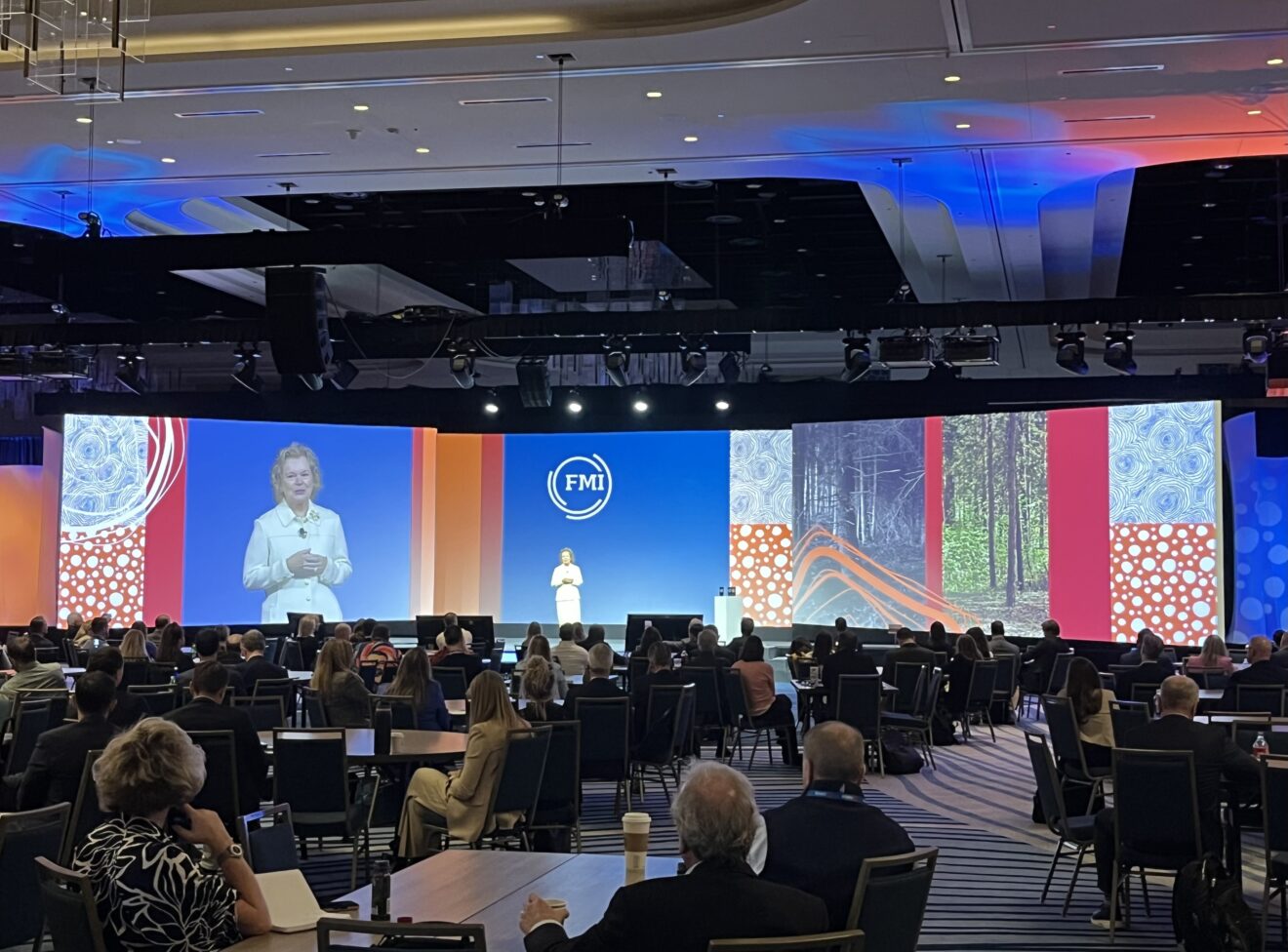
Nearly 1,800 grocery leaders gathered in San Diego last week for FMI — The Food Industry Association‘s 2026 FMI Midwinter Executive Conference, where discussions reflected a shared focus on how artificial intelligence, collaboration and organizational change are shaping the industry’s next phase.
Across sessions on AI, retail media and leadership, speakers consistently described AI as moving beyond experimentation and pilots, positioning it instead as a strategic capability increasingly embedded in how retailers, brands and store teams operate.
From data sharing to shared outcomes
A central theme was AI’s role in enabling deeper collaboration across the grocery supply chain. Speakers described how AI can be used to interpret shared data and translate it into insights that inform decisions for suppliers, distributors and retailers alike.
“I think the role of AI is actually taking data sharing and transforming it into what that data is going to mean in terms of changing plans for suppliers, for us as distributors, and for retailers,” said Andrew Connell, EVP and chief procurement officer at C&S Wholesale Grocers, Inc., in the session Stronger Together: Retail–Supplier Synergy for the Next Era of Grocery. “What really matters is to have that data influence the way each of us operates.”
Across sessions, industry experts discussed applications of AI beyond planning, including forecasting, inventory visibility and store-level execution. Speakers described how shared data and AI-enabled tools are being used to support closer coordination between suppliers, distributors and retailers.
Adam Stave, CEO of Swish Brand Experiences, a programmatic sampling technology that modernizes food sampling via online grocery orders and winner of the 2026 FMItech Pitch Competition, reinforced these points in an interview with SmartBrief at the conference.
“What I’m excited about in the space right now, maybe it’s old things that are new in terms of the way that retailers are making their data available and actionable for some exciting programs, whether it’s to train agentic shopping programs, or programs like Swish, where we use that data to add relevant products to people’s orders,” Stave said. “Opening up that data… 10 years ago, if I called on a grocery retailer and asked them for their order data and told them what I was going to use it for, they might have closed the door on me, but it’s table stakes nowadays, that this data can really be used to create great experiences for their customers, [and] move more product.”
Preparing for the agentic consumer
Sessions also explored how agentic AI could influence the future of retail and consumer decision-making, particularly as AI agents become embedded in smartphones and other consumer devices.
“My forecast in general is by ‘28 and ‘29, most consumers who have bought a new cell phone, for example, Google or Apple, embedded on those phones will be an option for one LLM or another. And when you choose that optionality, what will happen is you’ll pick your LLM, pick your agent and then you, the consumer, will set your own parameters on that data. What data will I let people see? What retailers do I want this agent to interact with? What products do I need?” said Dan O’Connor, executive fellow, Harvard Business School, in the keynote “Winning the Agentic Consumer.”
Speakers discussed how this shift could change how consumers discover products and make purchasing decisions, placing greater emphasis on data quality, accessibility and trust.
“A brand’s mission, much like a retailer’s mission, is getting the right message to the right consumer at the right time,” said Guy Peri, chief information and digital officer at McCormick & Company. “That doesn’t change — but the how changes a lot with agentic AI.”
AI moves beyond pilots: From strategy to the store floor
Sessions also focused on practical applications of AI already being deployed in grocery operations. Speakers discussed use cases including task automation, fresh inventory management, labor reallocation during disruptions and consolidating data into actionable insights for store teams.
“One of the things I hear all the time is there’s plenty of data, but not a lot of actionable insights,” said Mike Sanders, CEO of Upshop. “If that data can be used to drill all the way down to outcomes and assign tasks, then you get real value for everyone in the space.”
In the session “From Insight to Aisle: How AI Guides Store Teams to Execute the Brand Promise,” speakers described how AI can help connect strategy to execution by delivering prioritized actions to store associates, rather than relying solely on dashboards and reports.
“Generative AI is no longer being confined to just pilots or experiments. It’s increasingly embedded in core workflows and in the core jobs for merchants and operators,” said Afresh CEO Matt Schwartz in the session “Generative AI in Grocery: How AI is Rewriting the Rules.”
Across sessions, speakers emphasized that technology alone is not sufficient for successful adoption. Organizational readiness and workforce alignment were repeatedly raised as critical considerations.
Andrew Wilson, VP of customer loyalty and AI at Wakefern Food Corp, shared his view that AI should not be siloed within specific roles.
“We didn’t have a vice president or director of phones, we didn’t have a vice president of internet — we shouldn’t have a vice president of [AI] or chief AI officer,” he said. “Everyone owns AI.”
Speakers also discussed AI’s role in supporting human decision-making and expanding capacity, rather than replacing people. Leon Zhang, co-founder and CEO of BetterBasket and an FMItech Pitch Competition finalist, echoed this perspective in an interview with SmartBrief, describing human-centered technology as one of the most compelling aspects of food retail innovation.
AI ROI: Investing in transformation
The session “Delivering AI ROI from Strategy to Shelf” addressed how grocery leaders are evaluating AI investments and measuring impact. Keith Mercier, vice president of worldwide retail and consumer goods at Microsoft, emphasized the importance of tying AI initiatives to defined business objectives.
Examples were shared where AI is being applied to areas such as demand forecasting, replenishment and pricing, with a focus on aligning strategy and execution. The session underscored that without clear alignment to business goals, AI initiatives risk remaining experimental rather than delivering sustained value.
Leadership, advocacy and collective action
As AI accelerates change across the grocery industry, FMI leaders emphasized that technology alone will not determine outcomes. In an increasingly volatile policy and operating environment, executives pointed instead to advocacy, food traceability and organizational resilience as decisive factors — reinforcing that while AI can reshape processes, outcomes will ultimately hinge on human leadership, collaboration and values.
“There’s no indication that the rate of change is going to slow down,” FMI President and CEO Leslie Sarasin said during her keynote, urging leaders to adapt without losing focus. “If we face our brittle world with the resilience and creativity we demonstrated before… confront anxiety with active empathy… remain attentive to one another… accept the nonlinear reality of things and remain in the moment and draw upon our improvisational instincts… and bond together honoring the diverse perspectives all around us, united, we will punch holes in the shroud of incomprehensibility, letting in the light.”
The takeaways
Across FMI Midwinter, speakers consistently returned to a set of interconnected themes: the importance of linking strategy to execution, preparing for emerging consumer behaviors and strengthening collaboration through shared data and aligned teams. The discussions framed AI not as an endpoint, but as an enabler, dependent on leadership, coordination and execution to deliver value.
Related stories:
- FMI’s Leslie Sarasin on what’s ahead at the 2026 Midwinter Executive Conference
- Three companies looking to transform the grocery technology landscape
- Five reasons family meals are more important than ever
_____________________________________
If you liked this article, sign up to receive the FMI dailyLead, a daily newsletter covering the food retail industry. Check out the rest of our SmartBrief Food & Beverage newsletters and connect with us on our SmartBrief on Food & Beverage LinkedIn page.