
In business, groundbreaking ideas rarely emerge from a flash of insight. More often, they’re the result of testing, iteration and perseverance.
No one knows that better than Zhang Yiming, the founder of TikTok. His first venture was a real estate app that fed home buyers images of residential properties. That company faltered, but the experience sparked an idea. What if, instead of matching people with homes, he matched them with entertaining content?
To find out, he created two apps. One was called Funny Pictures, and the other, Pretty Babes. Zhang’s early experiments fine-tuned an algorithm that curates viral content, laying the foundation for TikTok, a social network that has since taken the world by storm.
It’s rare for a workplace experiment to spark a billion-dollar business, but billion-dollar businesses thrive on relentless experimentation. Take Netflix. What began as a small test — mailing a DVD — grew into a global entertainment powerhouse, fueled by its commitment to experimentation.
Today, Netflix conducts thousands of experiments each year, tweaking everything from movie thumbnails to its recommendation algorithm to the production of niche shows. The company even offers courses on experimentation, led by its founder, Reed Hastings, showcasing past experiments that have contributed to the company’s success. Employees at every level are encouraged to pitch ideas, even in areas beyond their job descriptions.
Over the last few years, my team set out to answer a simple question: What do the best teams do differently? We surveyed thousands of workers across a wide range of industries and identified a small group of teams that consistently outperformed their peers. We call them Superteams, and looked closely at what set them apart.
One pattern stood out. Superteams approach their work together much as successful companies approach innovation. They experiment relentlessly.
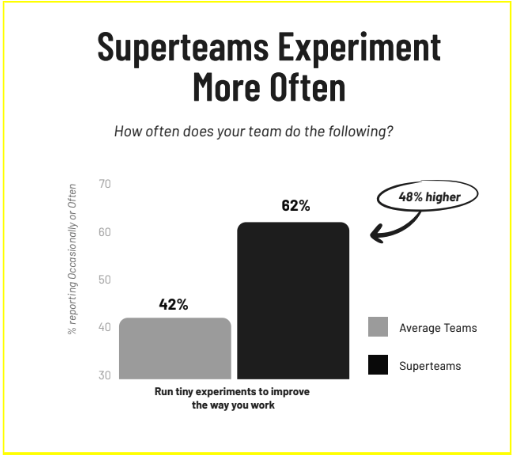
Plenty of companies talk about continuous improvement. But without the freedom to run experiments, meaningful progress is impossible. If your team delivers solid results but rarely tries new approaches, here are three simple guidelines to help you ease into experimentation:
1. Keep failure small
The best experiments provide useful information without costing much time or money. That’s the essence of what psychologist Amy Edmondson calls an “intelligent failure.” One example comes from Lendlease, an Australian real estate firm. Instead of spending months developing a new service, they ran Facebook ads inviting customers to join a waitlist. For just a few hundred dollars, they confirmed demand. And even if no one had signed up, the experiment would still have been a success, saving months of wasted effort.
2. Remember to stretch
Once you’ve minimized the cost of failure, be sure to test many things, not just the obvious ones. That’s the mindset at Amazon, where thousands of experiments run each day, testing everything from product descriptions to homepage layouts. “To invent you have to experiment,” Jeff Bezos has said, “[but] if you know in advance that it’s going to work, it’s not an experiment.” His point is that the best experiments extend beyond obvious improvements and involve some level of risk. If all your experiments feel safe, that’s a pretty good sign that you’re not thinking big enough.
3. Err on the side of learning
When it comes to selecting between experiments, don’t just pick the one that’s most likely to succeed. Choose the one that will teach you the most. That’s the lesson Astro Teller has taken away during his decade leading Google X. Sure, Google X has its share of high-profile flops — most notably, Google Glass. But in Teller’s experience, so long as an experiment delivers a valuable insight, it’s not really a failure.
Adapted from SUPERTEAMS: The Science and Secrets of High-Performing Teams (Simon & Schuster, June 2)
Opinions expressed by SmartBrief contributors are their own.
____________________________________
Take advantage of SmartBrief’s FREE email newsletters on leadership and business transformation, among the company’s more than 250 industry-focused newsletters.