All of us have projects.
If you agreed to oversee a project, my guess is you believe you can. And why not? You know your industry, value good communication and are goal-oriented. Software programs automate reminders, make source documents accessible to teammates and allow processes to be mapped in painstaking detail. Later, after project highs and lows, the team will congratulate itself for meeting goals – and especially the ultimate goal: It got done.
So why are cost and budget overruns so common on US construction projects? Estimates vary based on building sector and surveys, but overruns are widely considered endemic. Only one in five construction leaders surveyed this year by solution provider Slate Technologies says they can successfully address project delays. Almost half add that they don’t trust cost and time estimates provided by their forecasting and budgeting tools.
The knee-jerk reaction is to say, “That’s an industry problem, as much as a project management issue.”
I hear ya.
Confession number 1: I may have even said it.
While I’ve never managed anything at the scale of a major infrastructure project in the AEC industry, I’ve managed plenty of other types of complex, high-stakes, multi-stakeholder assignments. Here’s what I’ve come to realize: If missed timelines and budgets are the norm, the norm needs to change. That can begin with any of the key stakeholders, but there’s no guarantee that they’ll follow suit without seeing it, such as in a timeline or budget. Excellent project management is a great way to influence all potential factors – and people. Often, it’s the only way. The constant negotiations involved in managing a project make the process messier than a straightforward project plan makes it look.
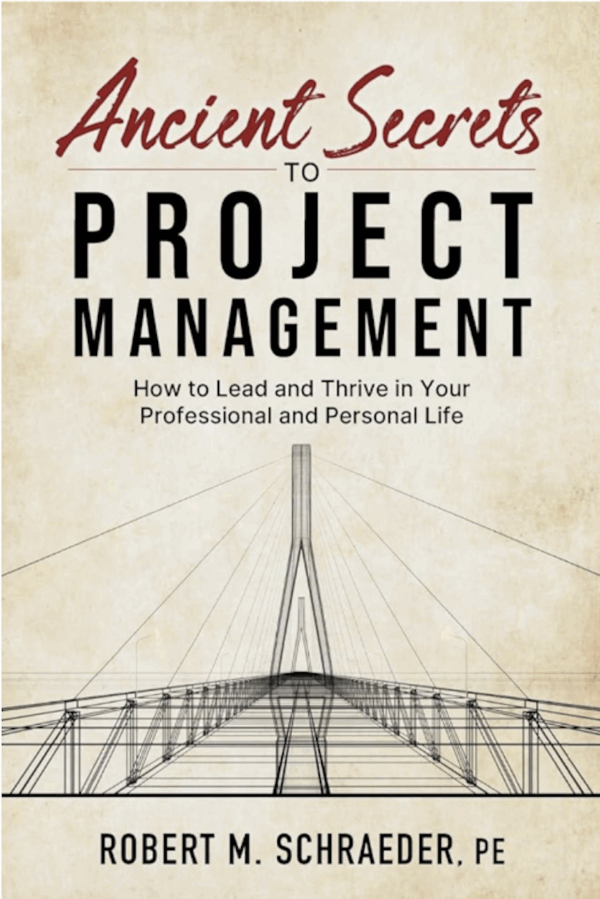
Civil engineer Robert Schraeder knows this better than most. Over his career, Schraeder estimates that he’s overseen the design and construction of about $4 billion worth of projects, including complex freeways, light rail, dedicated bus lanes and a signature cable-stayed bridge. What initially impressed me, though, was the title of his newly published book: “Ancient Secrets to Project Management: How to Lead and Thrive in Your Professional and Personal Life”. Perhaps it wouldn’t push software on me.
Spoiler alert: Schraeder mentions software.
How could he not?
Despite a history of slow technology adoption, the construction sector sees its value. In August, the Associated General Contractors of America launched its first technology-focused conference. A 2025 survey by Deloitte and Autodesk found that only 37% of construction firms use machine learning and AI. While low, this is up 11 percentage points from the same survey conducted in 2023.
Project management software has only a supporting role in “Ancient Secrets” and comes with caveats. For example, the person running the software may not have a strong understanding of all the processes it documents. (Something tells me Schraeder’s seen this first hand.) Responsibilities may be delegated via software, but they require continuous personal oversight.
Schraeder also warns against completely delegating responsibility for something that you, as the project manager, don’t understand well. If the field of specialization could lead to delays, Schraeder says it’s the PM’s responsibility to do a deep dive and get educated in it to help foresee issues. Nobody will tell a PM to do that, but Schraeder recalls the times he’s done it and how he was able to help mitigate risks. This could be construed as “hovering”, but Schraeder warns against that, too.

Leading is more than managing, he writes.
One of Schraeder’s favorite workplace memories was hosting a staff dinner on the bridge the team had recently completed. (In the book, he doesn’t name the bridge, but he has confirmed to me that it was the Long Beach International Gateway Bridge.) It wasn’t for the press or the public; it was just for those who put in the actual labor. Sharing pride in a job well done permeates Schraeder’s management style.
So does leading by example, which includes tactfully navigating disagreements. Schraeder shares detailed examples of trying times with partners, owners and even colleagues. It’s easy to be calm in retrospect, but hard in the moment. Schraeder’s documented confrontations provide some of “Ancient Secrets’” most illuminating lessons.
Also valuable is Schraeder’s detailed discussion of project specifics, such as change orders. A software program is only the beginning. Managing change order risk requires documented conversations with all stakeholders, dedicated budget allotments and project-customized processes. Of course, many project management do’s and don’ts are well known in principle. “Ancient Secrets” doesn’t belabor the basics; it provides context.
Project management is human management.
If readers could take only one lesson from “Ancient Secrets“, it’s that. Schraeder shares techniques that have helped him protect and fortify teammates, as well as build strong relationships with stakeholders. He also documents times he’s made mistakes, which is refreshing.
Even mistakes that seem small at the time can snowball, derailing projects, as well as a PM’s personal life. Schraeder learned that the hard way when an especially challenging project put him in the hospital, leading to difficult conversations with his family.
Most books on project management don’t mention life outside the office or jobsite, as if they’re church and state. Schraeder doesn’t, making this book a keeper not only for its project management teachings, but also as a life management guide.
Confession number 2: I have dozens of self-help books.
Collected over decades, they are friends who sit on my top bookcase shelf, ready to guide, cajole or inspire when needed. Schraeder sandwiches his project management advice between what I’ll call lifestyle chapters. He also weaves Bible verses throughout, which I found distracting at first. Later, I appreciated them as subtle reminders that these lessons are timeless.
“Ancient Secrets to Project Management” will sit with my business books, but Schraeder and I will probably visit for his life advice as much as project advice. After all, leading a complex, multi-year project can be all-encompassing. In the same way, living can feel like a project.
The book is available at Amazon and Barnes & Noble.
If you enjoyed this article, subscribe to SmartBrief for Civil Engineers or one or more of SmartBrief’s more than 30 infrastructure newsletters.