Agile project management, not long ago only a software development term, is now applied in multiple sectors, including health care, education, government, advertising and, increasingly, construction. Consider that:
- Public Private Partnerships (PPP or P3) are rising in importance in the US to meet infrastructure requirements, according to JLL.
- McKinsey is urging data center designers and builders to collaborate more effectively on design and construction to better meet the demands of AI.
- Innovation will be key in 2026 to maintain profit margins in the engineering and construction industry, according to Deloitte.
- A method of project delivery is emerging to better enable innovation throughout a project’s lifecycle.
All of these concepts are based on an almost counterintuitive idea: That adding more stakeholders – more specialists, more meetings, more sharing, just more – to a construction project early on makes a project easier, not harder. Yet, that’s the concept increasingly adopted in the construction industry, especially on very large projects. Project delivery methods (PDM) are adapting so that architectural, engineering and construction teams can, too.
With less than a decade in practice and primarily supporting the health care sector, a lesser-known PDM remains an outlier but may grow in importance. The overarching goal is to build a multidisciplinary team able and incentivised to communicate well throughout a project’s life cycle. It’s hoped that, together, the team can efficiently mitigate design, site, cost, supplier and timeline risks.
INTEGRATED PROJECT DELIVERY (IPD) takes project collaboration to its extreme.
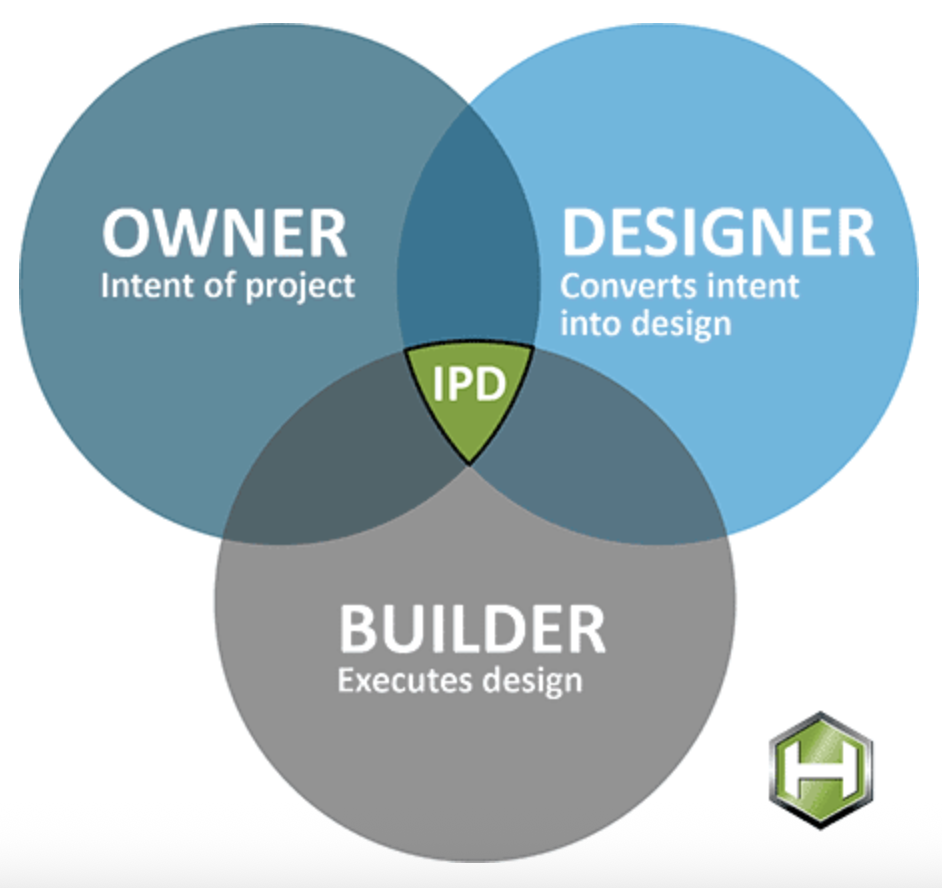
The latest project delivery method gaining momentum fully embraces this concept – far more so than its competitors. Integrated Project Delivery (IPD) brings all stakeholders under a common contract, in which each faces an equal profit risk, according to the Lean Construction Institute.
It mandates collaboration among stakeholders across the life of a project. At a minimum, that includes the project owner, general contractor and architect, although it also may include many more partners, such as suppliers and subcontractors. The American Institute of Architects (AIA) provides template IPD agreements. Participants regularly waive liability claims against one another. They may also organize under a joint limited liability company.
IPD works well on complex projects that require an adaptive and innovative team. One of the best-known IPD projects is the Inspira Medical Center, which opened five years ago in Mullica Hill, N.J. Shortly before the project was completed, Rebecca Pizzi, a project executive at Skanska, explained to Engineering News-Record that IPD created a collaborative and transparent team environment.
“The behaviors and the communication are quite different than you would have in a design-build or traditional delivery method,” Pizzi said. “Everything moves to what is as efficient as can be, whether it’s cost or schedule. In a traditional method, everyone has layers of contingency and their own budgets.”
That much freedom of choice might not sit well with some project owners. While an IPD is likely to emphasize lean principles and anticipate process iteration – even innovation, IPD stakeholders may opt for best-value vendors instead of focusing solely on the lowest costs. Contracts may also include a shared profit pool, and an IPD project requires a healthy cash infusion at the beginning. As such, public agencies may be limited in their ability to adopt IPDs without additional stipulations.
IPD is the antithesis of old-school DESIGN BID BUILD (DBB).
IPD and the traditional, old-school Design Bid Build (DBB), which builds projects almost as if they were on an assembly line, sit at opposite ends of the PDM spectrum. With DBB, project responsibility is handed over to the next stakeholder, who then passes it on to the next, and so on, until the project is completed. DBB begins when the owner hires a designer. The designed project then goes out to bid. A lead contractor is hired to build it, who hires subcontractors to complete the work.
DBB remains a familiar favorite, although increasingly, it has become relegated to medium-sized projects. Litigation has become too pervasive when using DBB on highly complex projects. For the really big projects, the preference is for Alternative Delivery Methods (ADM or APDM). (“Methods” is sometimes replaced with “modes” or “systems.”)
A DBB that shifts risk to the builder is called CONSTRUCTION MANAGEMENT AT-RISK (CMAR).
Also referred to as the Construction Manager/General Contractor (CM-GC) model, Construction Management at Risk (CMAR) begins with two contracts: one for the contractor and another for the designer, who are encouraged to collaborate well, just like in an IPD.
Value engineering is employed to find a project’s Guaranteed Maximum Price (GMP). End under GMP, and the CM will gain a monetary reward. End more than GMP, and the CM must absorb the loss. An Engineering News-Record survey published in mid-2025 suggests CMAR is gaining ground. The survey estimates that almost 40% of major US projects may use the method.
This year, when bids for a 3.2-mile light rail system in Southern California came in way over budget, local authorities changed the PDM to CMAR to “reduce unnecessary risk money that is added by bidders,” the local government authority spokesperson Lucy Levy Buch told Engineering News-Record in April.
“CMAR does that by having the designer work alongside the CM; but the CM doesn’t have to bid the job until design is nearly to 100%, so they help make sure we take advantage of all avenues to save money,” Levy Buch said.
DESIGN BUILD (DB) – the original ADM – keeps getting retrofits.
IPD is the latest ADM. The first was design-build (DB). While the designer often oversees a DBB, the construction contractor often leads a DB. Still, the designer and contractor share a contract, which encourages collaboration and shifts significant project risk from the owner to them. DB contracts may include fixed prices or a price cap.
Almost half of US construction projects use DB, according to a 2025 report from the Design-Build Institute of America, which forecasts that the PDM will account for $2.6 trillion worth of projects from 2024 through 2028.
Some AEC professionals have found the DB model shifts too much risk to them, leaving them vulnerable if project prices or parameters change, so multiple alternative DB models have emerged.
One DB offshoot is Design Assist, which adds manufacturers to early project discussions to aid value engineering, code compliance and other efforts. It works best for projects without prescriptive specifications.
Another model is Progressive Design Build (PDB), which brings the project owner back into the project management team and can include additional stakeholders. Contract commitments are only signed once a substantial portion of the design is complete, thereby mitigating some risk. PDB has become a popular choice and is considered a rival to the DB model.
Another way to balance the risk taken is to add a reward, as with Design-Build-Operate (DBO), which promises a more holistic project approach. It may also include maintenance, leading to the DBOM model.
Knowledge of PDMs is powerful, even for those less familiar with the concept.
The energy infrastructure sector has traditionally tried to manage risk by assigning an entire project to a single, specialized contractor. The Engineering, Procurement and Construction (EPC) model is commonly used to build power stations, oil and gas facilities, and solar and wind farms. However, even EPCs have grown weary of the model’s lump-sum contracts. Some are calling for an end to fixed-price delivery and are asking project owners to take on procurement and schedule risk. Several ADMs offer potential solutions.
Of course, choosing a PDM could be considered a luxury. Most PDMs are chosen long before contractors get involved. Yet, understanding that there are multiple ways to share project risk and reward is important, even after a project starts. Complex projects are more common and more likely to require flexibility from all stakeholders. New ways of working collaboratively are essential, especially when the stakes are high, as they always are on projects meant to last a lifetime.
If you enjoyed this article, subscribe to SmartBrief for Civil Engineers or one or more of SmartBrief’s more than 30 infrastructure newsletters.