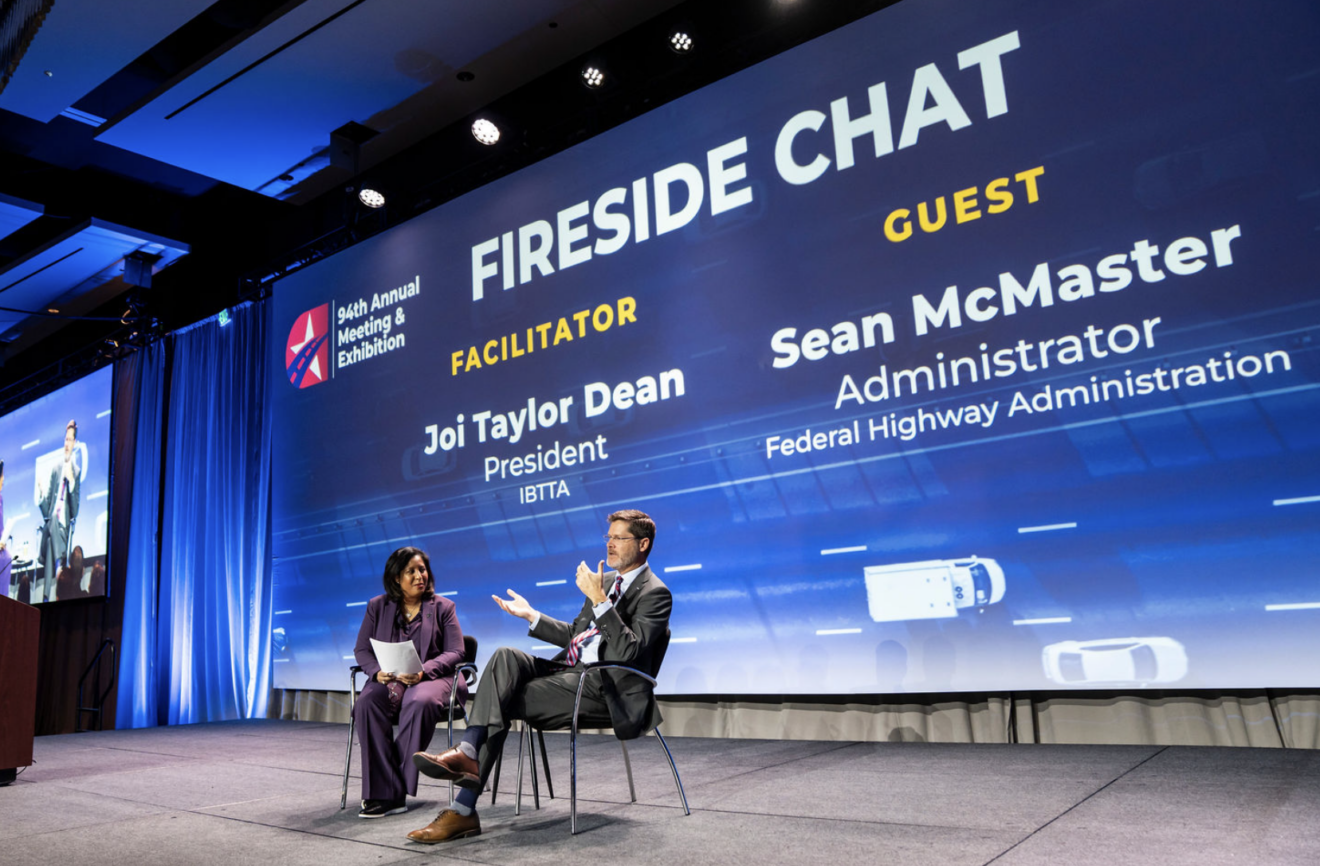
The federal government has a list of 206 highway bottlenecks and an estimate of $261 billion to fix them. It does not have $261 billion.
Federal Highway Administration Administrator Sean McMaster said as much during the International Bridge, Tunnel and Turnpike Association’s 94th Annual Meeting & Exhibition in Arlington, Texas. States submitted the bottleneck list under the Freedom to Drive initiative that the Transportation Department launched in April. Public budgets cannot always cover it, McMaster told a room of tolling and public transportation professionals, so the Trump administration believes private investors could help.
The same idea has been surfacing across the conference from very different places. A federal official, a Greek toll road executive and a technology supplier working in India each described governments turning to private money because public money has run short. Each also described the price of that choice.
Washington, D.C., widens the door
McMaster pointed to partnerships already in motion. Georgia is using a privately financed model for express lanes on Interstate 285 in Atlanta. Tennessee plans priced “choice lanes” on Interstate 24 between Nashville and Murfreesboro that a private partner would design, build, finance, operate and maintain.
Transportation Secretary Sean Duffy wants the US to be the top destination in the world for private transportation investment, McMaster said. His agency is also helping states set up infrastructure banks.
The most direct news for toll agencies involved existing interstates. Federal law mostly limits interstate tolling to new lanes and to rebuilt bridges and tunnels. A pilot program that sat unused for years lets up to three states toll an existing interstate to pay for its reconstruction. Alabama is the first state to start a project under it, McMaster said.
McMaster paired the financing pitch with a promise of speed. The median environmental impact statement used to take close to eight years, he said. He says it now takes 33 months against a legal target of 24 months.
Greece writes rules for the uninvited bid
Greece reached the same conclusion earlier and under harder conditions. The country’s debt crisis and the end of European cohesion funding left no money to plan new roads, said Bill Halkias of the New Attica Tollway Concession Co. Halkias is president emeritus of HELLASTRON, the Greek toll road association.
Southern European countries built their motorways through toll concessions because they lacked the tax revenue to fund them directly, Halkias said. Italy and Spain already allow unsolicited proposals. France treats them with caution.
Greece’s response was a 2022 law that lets private firms propose projects the state never asked for. Lawmakers amended it this year after a long public argument over whether builders would simply propose what suited them.
The safeguards are the instructive part. A proposer must submit a preliminary design, a cost estimate, environmental work, a cost-benefit analysis and a delivery schedule. One committee evaluates the proposal and a government committee makes the final call. Approval earns the proposer a place in the competition and nothing more. The contract goes to the best financial offer. A rival that wins must repay the proposer’s preparation costs. A proposer whose idea is rejected gets nothing.
“If his proposal was not advancing, then he was losing his shirt,” Halkias said.
No project has been selected yet. Two bypass routes around Athens are the likely first tests. Halkias expects the approach to shorten a preparation period that typically runs about 10 years. Congestion in the capital could be a leading issue in the next election, he said.
India tests how much risk a bidder will carry
India offers the short-term version of the same bargain. The country is replacing gated toll plazas with free-flow gantries. The first went live on May 1 in Gujarat. The plan calls for more than 1,000 gantries in three years with roughly $1 billion in private funding, said Carl Brown, president of SIDRA Systems.
The structure pushes risk downhill. A bank wins the bid and carries ultimate responsibility. The bank hires an integrator that finances and builds the site. Technology suppliers such as Brown’s firm equip the lanes. Penalties for missed tolls or bad notices pass down the chain. Payment comes per transaction. About two dozen Indian banks qualify to carry that risk and a recent package drew 14 bidders, he said.
“Five months to build it, five years to run it,” Brown said.
That makes traffic the whole business case. Brown’s team did its own vehicle count before bidding because the official number looked low. Other promises held up less well. The command center the team was promised had termites and a leaking roof, he said. The promised electricity was not there.
He showed a photo of trucks parked at a free-flow gantry and explained how it happens. A tea seller sets up nearby, one trucker stops and others follow.
Brown polled the room on whether they would sign up for such a project. About two-thirds said no. His request to agencies was more data up front on power, local cooperation and site conditions.
The upside is real too. Revenue rose 10% to 20% after the gates came out, Brown said. His firm is installing four gantries for about $1 million. He said the same work would cost tens of millions in the US.
Virginia shows the long version
The US example on the panel sat at the other end of the scale. Interstate 66 in Northern Virginia was rebuilt under a 50-year concession backed by $3.7 billion in private investment. The 22.5-mile corridor opened in 2022 with two express lanes beside three general lanes in each direction.
The private money bought more than toll lanes, said Ahmed Amer of VHB, whose firm worked on integrating the corridor’s systems. The project added more than 4,000 park-and-ride spaces and bike trails and reserved the median for future transit. Tolling, traffic management and fiber were built as one system that the state and the developer share.
Amer’s advice was to bring technology vendors in before a project starts and to track down records for older infrastructure early.
Long terms create their own problem. Roadside equipment does not last 50 years.
Cables start cracking after about three years in heat and rain, Brown said. Halkias said the Attica Tollway’s systems date to the early 2000s and people who know the code will soon be hard to find. He suggested that contracts require a technology upgrade every five to seven years.
The takeaway for agencies
Private capital is no longer being pitched as an alternative. For the projects on McMaster’s list it is the plan.
The panel’s lessons point the same way. Write the rules for unsolicited bids before the bids arrive. Give bidders honest data on traffic and site conditions. Budget for technology that will age faster than the contract.
Brown offered the simplest due diligence of the day.
“I would go sit at a roadside, look at the road I’m going to buy and have a cup of tea and see what’s really going on there,” he said.
Want more news on how toll roads are financed, built and run? Subscribe to IBTTA SmartBrief.