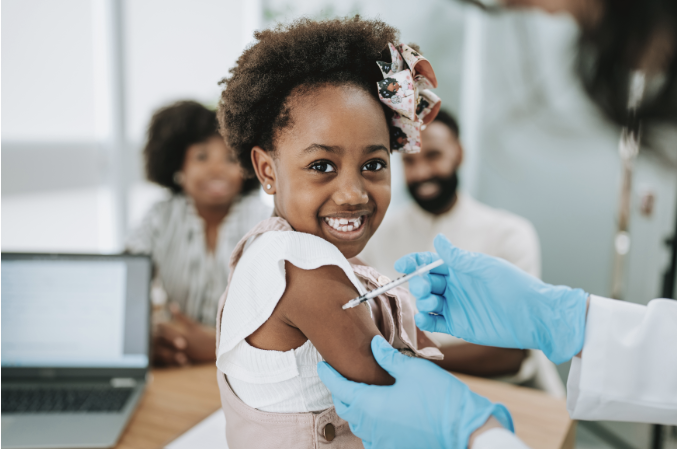
Changes to the pediatric vaccine schedule pose challenges for public health communicators as they navigate the new landscape, panelists said during a recent Public Health Communications Collaborative webinar. How can they keep information about immunizations simple and clear? How do they meet patients where they are in terms of openness to vaccines? How can they address their concerns about vaccines and misinformation around vaccines?
The CDC last year changed COVID-19 vaccine guidance from universally recommending the shot to shared clinical decision-making, and in January reduced the number of childhood vaccines to 11, compared with 17 that were recommended at the end of 2024.
As a result of these rapid federal changes, states and medical societies have issued recommendations that contradict federal guidance, complicating public health professionals’ work. Northeast states, along with New York City, banded together to launch the Northeast Public Health Collaborative, while West Coast states formed the West Coast Health Alliance in response to changes to the CDC’s vaccine panel and recommendations. Both organizations have rejected the CDC’s vaccine recommendations and have endorsed the American Academy of Pediatrics’ guidance.
The American Medical Association also announced that it, along with the Vaccine Integrity Project, will conduct an evidence-based review of influenza, COVID-19 and respiratory syncytial virus vaccines for the 2026-27 respiratory virus season.
The affirmative case for vaccination
In light of conflicting guidance, Julie Sweetland, who has been working closely with AAP on vaccine messaging, said the most important thing public health communicators can do is make an affirmative case explaining their thinking and ensure information is presented out of concern for children and the community. That differs from an adversarial approach that pits “our science versus their science,” Sweetland said.
“Anything we’re doing that could be seen as polarizing is unhelpful in this issue. It’s not that we don’t have a side or position; we do have a side on the side of children’s health, on the side of science and evidence and vaccination,” she said. “It’s not a partisan fight, and anything we’re doing that leaves that impression is undermining trust.”
Dr. Kelly Kimple, director of the Public Health Division at the North Carolina Department of Health and Human Services, said that patients do trust their health care providers and encourages them to talk to their physician about immunizations. “I think it’s really trying to ensure people have access to clear information, trying to focus on, has there been a change to the data?”
Messaging and trust
Focusing messages around protection and children’s health is key, Kimple said. Much like people who support vaccination, people who are concerned about vaccines are also thinking about perceived protection, she said, highlighting research conducted in North Carolina on residents’ openness to vaccines.
Who delivers the message is also important. “Is there somebody in the community, another organization or somebody who is really going to be a better messenger for that? There aren’t shortcuts. At the end of the day, we are still building trust and motivating persuadable parents,” Kimple added. “We know it’s really easy to take trust away, and it’s hard to build it back.”
Panelist Dr. Ram Koppaka, a vaccine policy adviser who previously worked at the CDC, spoke about the importance of understanding the audience and making it clear as a messenger that their perspective is understood. As a starting point for the conversation, he suggested finding commonalities.
“As public health communicators, we will stay true to the science and make sure the messaging is grounded in science, while acknowledging there are other perspectives and trying to build a bridge to those other perspectives,” he said.
Research backs this up, Sweetland said. Parents who have some skepticism and are open to conversations value scientific information, but they want it explained clearly and simply, without condescension, and also in a way that places the context around their own child. It was also important that the pediatrician was respectful of parents’ decision-making authority, she added, noting parents want to trust the physician, although they want the message framed as a recommendation.
Communicating the science
“Safe and effective” has become the phrase that health leaders and officials turn to when talking about vaccines and disease prevention, but that “does not work with anyone who doesn’t already believe it,” Sweetland said. Moving away from that assertion and prioritizing explanation is a needed change. One way to frame the conversation is to explain how babies’ immune systems are primed to learn and how vaccines enhance their readiness to respond. It can be equated to learning to read and developing literacy, which is good for the individual and the community, and that message can help parents move from “too much too soon” and toward “the earlier the better.”
Kimple added that it’s important to explain the “why” when communicating about vaccines and that “it is a constant balance of how much to explain and how to ensure that these are simple, straightforward messages that can resonate and do that quickly.”
It’s also helpful to explain that from birth, people are constantly exposed to germs and that vaccination is a controlled way to expose our bodies to germs so the immune system is prepared to respond when it encounters the real thing, Koppaka said. He underscored that it’s vital to understand parents’ sources of concern without making the discussion feel adversarial.
Misinformation and communication online
People are largely getting information about vaccines from social media and trying to verify it through Google searches, but there’s an opportunity to counter bad information, panelists said. For some families, learning about vaccines is a journey amid conflicting information.
“The current dynamic that we find ourselves in is perfectly designed to sow confusion because we are bombarded with messages from all sorts of different arenas and some proportion of them are accurate and a large proportion may not be,” Koppaka noted. “I think a lot of people have other things they need to focus on, and many people throw their hands up and say, ‘This is so confusing. I’m just not going to deal with it.’”
Part of that journey can include verifying information with physicians and local health departments, Kimple and Koppaka said. In North Carolina, people continue to trust those sources of information, Kimple added, noting that social media is on the low end of trust. It’s important to consider whether there are other sources of information people are using to verify what they saw on social media and build upon that as part of the journey.
Health care professionals who have a personal account where they share information around vaccines can engage with comments on their content and add context and facts, said Sweetland. She also suggested working with others to manage comments. She said that vaccine content should be one of many topics that professionals post about, and they shouldn’t hesitate to delete hateful or threatening comments.
Another benefit: answering questions on social media has the potential to help others on a similar journey and can help with considering where there are gaps in communication, panelists said.