
AI, and more specifically, agentic AI, was the biggest trend at NRF 2026: Retail’s Big Show, with a particular focus on its impact on commerce and the need for improved integration. Other notable trends include value-seeking consumers, quality and trust, price optimization and digital shelf labels. SmartBrief sat down with Deloitte’s Principal Brian McCarthy at the show to dive into these topics.
With 68% of retailers planning to deploy agentic AI in the next 12–24 months, what is the biggest hurdle for a legacy retailer in moving from experimentation to autonomous execution in their merchandising and pricing strategies?

McCarthy: The biggest hurdle is ensuring a robust data catalog that is machine-readable, including details on product attributes, inventory availability, pricing, promos and even policies (e.g., shipping, returns, warranties). This will make the difference in being seen or being looked over in agentic commerce.
Deloitte has found that value-seeking is now a permanent “structural change” in retail. Since retailers can’t just discount their way to growth forever, what is the one specific investment in quality or trust that actually moves the needle for a 2026 consumer?
McCarthy: I think it is different if you are a brand or a retailer. For brands, it is about depth and authenticity of product information, not only how it is presented online, but how accessible is this information to agentic commerce LLMs seeking to provide information to agents and humans shopping via this emerging channel. For retailers, it is about the accuracy of inventory information, ensuring stores have good in-stocks so consumers can trust that product is there when they shop, that information on inventory availability is accurate online and accessible for agentic shopping to avoid missed sales and poor substitutes.
AI-driven personalization is on the rise: How can marketers use AI to create “hyper-personalized” experiences that feel helpful and intuitive rather than invasive or “creepy” to a more skeptical 2026 consumer?
McCarthy: Consumers share so much information about where they shop, when they shop, what they shop for, etc. Collecting and using this information to provide better recommendations that are actually helpful, and at the right moments, will make the difference. The creepiness comes when executed incorrectly. For example, sending unprompted information/recommendations that are not part of an organic shopping journey or in providing too much information about what data was used to shape that recommendation.
Beyond just “seeing” the disruption in the supply chain, how can retailers use AI to proactively reconfigure their product mix or sourcing locations in real-time to protect their margins from these geopolitical fluctuations?
McCarthy: AI can be used to maintain high-quality real-time data accuracy, and it can be used to rethink workflows/process design with a focus on localized and personalized execution at scale. This is something that was not possible when relying solely on human labor as the upside would not be enough to offset the increase in operational costs. However, with AI and automation, it is possible for brands and retailers to shorten supply chains, increase localization and personalization, and do so with lower operational costs.
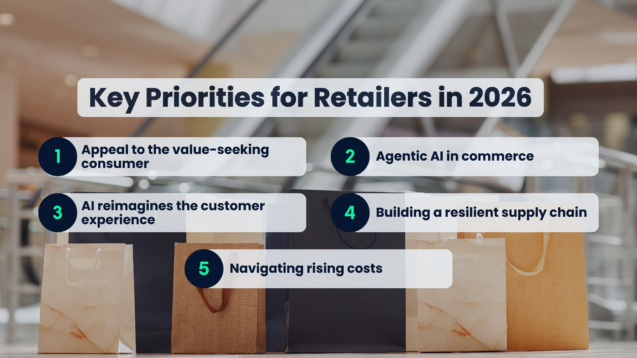
There is no doubt that this year will likely bring changes to the retail industry as consumer priorities shift. McCarthy’s take on NRF 2026 aligns with Deloitte’s 2026 Retail Outlook, which highlights five areas for retailers to focus on: appealing to value-seeking consumers, deploying agentic AI, using AI for personalization, building resilient supply chains, and managing rising costs. Nearly 70% of retail executives see value-seeking as a structural change, and most plan to use AI for operations and customer experience within the next two years.
If you want to stay current on the latest news and trends in retail, sign up for the NRF SmartBrief.