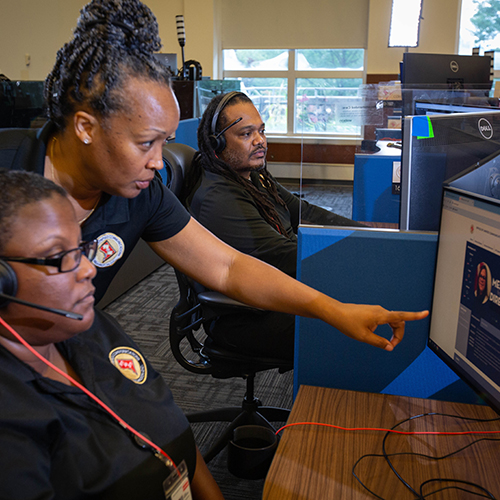
Every call to 9-1-1 begins at a public safety answering point. The PSAP is the local center where trained telecommunicators receive emergency calls and route them to the right responders. They’re the first point of contact to emergency response.
Today, that connection is under pressure. The demands on 9-1-1 have outgrown the systems designed to support them, and the gap is widening.
To meet the moment, public safety needs a more connected, modern and resilient approach. Leaders must embrace transformation with a 9-1-1 system built for how people communicate today.
Q: What are the biggest pressures facing 9-1-1 centers today?
Staffing shortages and rising call volumes are real challenges. But they are symptoms of a deeper shift. Many PSAPs rely on systems built for a voice-first, analog world. Today’s citizens expect more. They expect digital-first engagement, where they can share video and text data seamlessly and in real time, and precise location is built in, not optional.
Yet systems remain fragmented. Telecommunicators often have to bridge gaps between disconnected tools. Agencies that want to grow may risk disrupting their current service. Resilience often depends on local infrastructure rather than network-level intelligence.
This is more than day-to-day operating pressure – it is systemic risk.
Q: What capabilities are essential as agencies transition to NG9-1-1?

Next Generation 9-1-1 (NG9-1-1) is more than a system upgrade. It’s a new foundation.
It shifts emergency communications to a flexible and integrated software-driven ecosystem that connects agencies across jurisdictions.
The shift brings new capabilities. Some that matter most include:
- Nationwide interoperability, not regional silos
- Flexible, software-based systems that can adapt over time
- Built-in support for multimedia, including text, video and data
- Standards-based frameworks, like NENA i3, that enable innovation, long-term growth and vendor interoperability
Just as important is how these pieces fit together. Providers can integrate network and application layers into a seamless solution – so agencies aren’t left managing separate, siloed tools.
Q: How can agencies maintain service during outages or surges?
Resilience needs a broader approach than relying on backups at the PSAP level alone. Modern risks demand resilience that’s built into the system architecture.
Cloud technologies paired with highly resilient underlying networks enable this shift.
That means:
- Workloads can be rerouted automatically across locations
- Capacity can expand in real time during major events
- Failover can happen seamlessly, without disruption
The most effective models combine cloud flexibility with carrier-grade network reliability.
Across the industry, large-scale deployments of IP-based ESInet infrastructure demonstrate that resilience is strongest when delivered as an integrated service, not assembled from isolated components. They operate on nationwide networks built with multiple layers of backup and diverse pathways. These successes reinforce a broader lesson: Continuity depends as much on network design and operational scale as on application functionality.
Q: How are networks improving situational awareness and response?
Dedicated public safety broadband networks have expanded what’s possible. Networks that support NG9-1-1 go beyond voice updates from a dispatcher. They make it possible to:
- Route 9-1-1 calls based on a caller’s GIS location to minimize misrouted calls
- Include precise location data to improve response time
Connectivity is the foundation. The real value comes from integration:
- Data flows from caller to dispatcher to responder
- Systems synchronize across agencies
- Responders base decisions on a common operating picture
Networks, platforms and applications that work together help teams respond faster and more effectively.
The next decade will be defined by choices in network architecture.
Q: What should public safety leaders prioritize?
The defining decisions ahead are not about features. They are about the network.
Three priorities stand out:
- Build for scale, not just compliance. Systems must support growing data demands and emerging technologies.
- Make interoperability foundational. True coordination depends on shared standards across networks and platforms.
- Choose partners who operate at scale. As systems become more interconnected, reliability across the ecosystem becomes mission critical.
These decisions go beyond vendor preference to risk management. They help position agencies for long-term success and service to their communities. It is a defining moment for public safety.
9-1-1 is entering a new era.
NG9-1-1, cloud architectures and dedicated public safety networks are coming together to reshape emergency communications. This is not a technology refresh – it is a redefinition of emergency response. It’s a chance to strengthen how communities connect with help when it matters most.
The future 9-1-1 ecosystem will be:
- Connected across networks
- Driven by real-time data
- Interoperable by design
- Resilient by default
Anything less will fall short. Because in emergency communications, the cost of standing still is far greater than the risk of moving forward. Let’s work together with bold, thoughtful action today.
Learn how the AT&T ESInet™ Service has helped FirstNet transform emergency response.
FirstNet 5G requires a compatible device and is not available everywhere.
See firstnet.com/coverage for details.