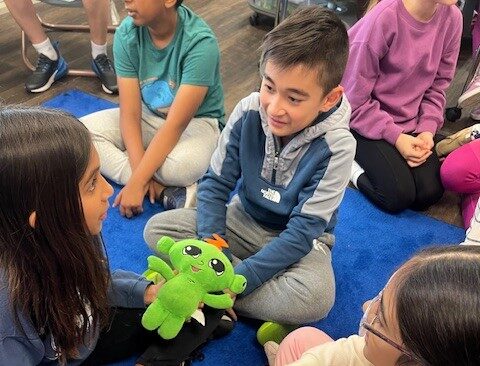

As AI reshapes how young people learn, communicate and connect, National University and Sanford Harmony are asking educators to refocus on relationships. Nick Yoder, PhD, Associate Vice President of Innovation & Research at Sanford Harmony and co-author of the new white paper Creating Harmonious Communities, explains what decades of research tell us and what schools can do with it.
Why focus on relationship science now?
Dr. Yoder: At our recent Relationship Science Summit, National University President Mark Milliron shared a story: Years ago, he was on a road trip with his wife and four kids when they stopped for gas. An older man told him, “You should clean the windshield — and I mean that in more ways than one.”
He meant that we all need to stop occasionally and ensure we’re seeing clearly what’s in front of us. That feels especially relevant right now.
Technology is changing how we interact, while young people are feeling lonelier and more isolated, according to the CDC.
This is a moment to clean the windshield and take a hard look at something decades of research tell us matters deeply to human development: the quality of our relationships.
What do you mean by “relationship science”?
Dr. Yoder: The field draws on decades of work in psychology, neuroscience, education, sociology and public health. But researchers have often studied one relationship at a time.
We’re asking how all of a young person’s relationships work together to shape their development.
Our framework looks at three things: where relationships happen, such as home, school and community; whom they’re with, including themselves, other people, and their communities; and the quality of those relationships.
Looking at the whole picture reveals gaps we’d otherwise miss. A student may have supportive friends, for example, but no strong relationship with an adult at school. Seeing that helps us understand how relationship quality shapes belonging, well-being and development.
Where does AI fit into this?
Dr. Yoder: Technology isn’t going away, and AI can be useful. At the Summit, we heard education leaders talk about ways AI can support adults in schools — supporting the educator in finding strategies that may help a student, for example — so educators have more capacity to focus on students.
The goal is to use technology to create more space for human connection rather than crowding it out. No tool can replace being known by a teacher or working through a disagreement with a classmate. Those experiences build the skills young people need. And as more young people turn to AI for conversation and advice, strong relationships with the people around them become even more important.
What does that mean practically for schools?
Dr. Yoder: It means treating relationships as part of learning rather than something separate from it.
And simply being around other people isn’t enough. Research suggests that relationship quality matters, especially whether young people feel cared for, supported, valued, and that they belong.
That might mean structuring collaborative work so students interact with different classmates, creating regular opportunities to talk and solve problems together, or making sure every student has an adult who knows them well. In the Harmony curriculum, practices such as Meet Up and Buddy Up create those kinds of intentional opportunities. The larger point is that relationships don’t have to be left to chance.
So where does the work go from here?
Dr. Yoder: We already know a lot about why relationships matter. The next step is connecting research, practice and partnership so we can strengthen relationships in real settings and then spread what works. Sanford Harmony is building a growing network focused on advancing healthy relationships, belonging and well-being to partner with us in that work.
Dr. Nick Yoder is a national expert on child development. He holds a Ph.D. in Education and Psychology. He coauthored the whitepaper Creating Harmonious Communities: Relationship Science for Learning, Belonging, and Human Flourishing.