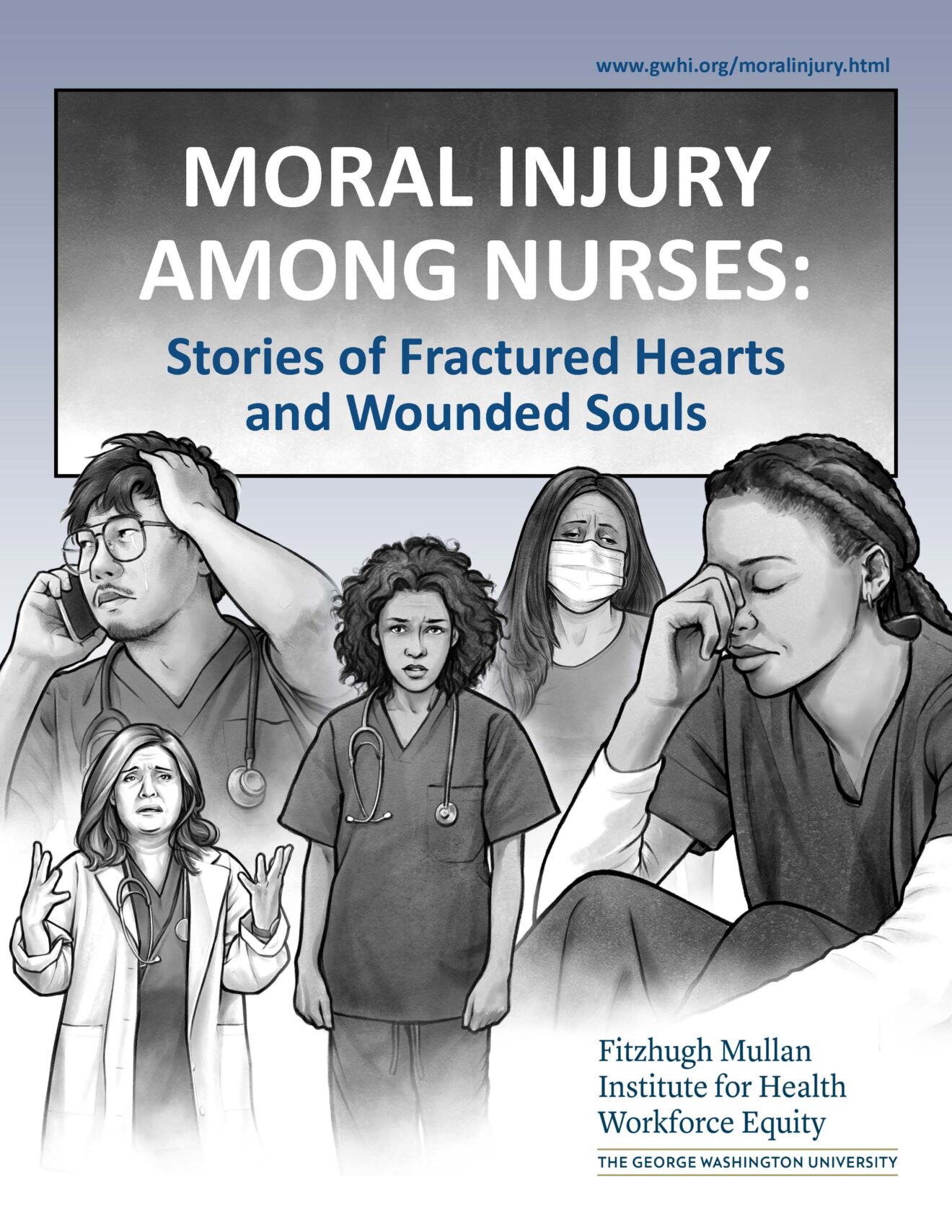
Burnout among nurses and other health care providers is a well-known concern, but for many nurses, the problem goes deeper, into an area known as moral injury. This came into focus during the COVID-19 pandemic, and researchers at the Milken Institute School of Public Health at George Washington University decided to raise awareness about the problem and provide insights that could help health care organizations and educators address it. The end result is a storybook that chronicles nurses’ stories about their experiences with moral injury and what it has meant to them professionally.
This Q&A features Patricia Pittman, who is in the Department of Health Policy and Management at the Milken Institute School of Public Health, and research scientist Lauren Muñoz, a nurse practitioner who also is at Milken. Both are involved in the development of the storybook.
Burnout is a well-known term among health care providers and the public, but how can we better understand what moral injury means?
Pittman: Moral injury in its most basic definition is the “psychological, biological, spiritual, behavioral, and social impact of perpetrating, failing to prevent, or bearing witness to acts that transgress deeply held moral beliefs and expectations” (Litz et al., 2009). It is one of the major causes of burnout, secondary trauma, compassion fatigue. In the voices of nurses we interviewed, it is often expressed as the anguish caused by not being able to advocate for patients and families in ways that their profession calls for and that patients need and deserve.
What prompted your research on moral injury among nurses, and did you face any challenges during your research?

Pittman: The research began prior to COVID-19 in a period when most of the work on nursing workplace distress, and its association with turnover, focused on burnout and resilience. We were increasingly hearing from nurses that the problem was far deeper and was centered on the experience of betrayal. Nurses were checking out because they felt their colleagues, their employers and the health system more broadly did not recognize their role and their knowledge. They felt it was impossible for them to remain true to their professional ideals in that context, and so they either went along with things they did not agree with and felt like they were selling out, or they felt like they had to quit.
So with this project we wanted to try and identify the range of experiences that nurses themselves described as moral injury, to categorize them and to consider whether there were ways to address these problems that had not been considered before. During COVID-19, when we were recruiting for this study, it was challenging to build out our sample. Nurses, I now understand, were in such deep pain that speaking about their experiences was difficult. As the pandemic subsided, we began to hear from more and more nurses as they tried to make sense of the periods before, during and after the pandemic.
Why create a storybook? Who are its intended audiences, and how might they use it?

Muñoz: When our team was interviewing nurses for this research study, we were incredibly moved by the experiences of moral injury they shared, and we realized that their stories should not be confined to a peer-reviewed publication, which would only reach an academic audience. We wanted patients, other health care workers and health professions students — including nursing students — to understand what nurses are facing. The intended audiences are broad because we hope that the storybook will give nurses a voice in forums where they have not always had a prominent voice in the past.
We included a list of questions at the end of the storybook to prompt discussion about moral injury experiences in health care. The questions can be used by nursing faculty to prepare nursing students for situations they will likely face in their own careers, and they can be a launching point for faculty to discuss ways to manage those situations. The storybook can also be used by nursing leaders — whether nurse managers, charge nurses or nursing administrators — to help nurses to process their own experiences of moral injury. Finally, we hope that the storybook will be used by health care administrators, physicians, patients and others outside of nursing to foster empathy for the situations nurses face and why they might, at times, seem to say or do things we don’t understand, or why they may be angry, fearful or resigned. As many of the nurses we interviewed told us, health care workers often do not have time to process their feelings or consider the impact those feelings are having on them and their coworkers. We hope the storybook will show how the nurses in the study processed their moral injury and help spark deeper conversations about moral injury, its drivers and potential solutions.
How did you go about compiling the stories, and what type of support, by institutions or individuals, did you receive?
Muñoz: For our project, we interviewed nurses who provide direct clinical care, including those in lower-level management positions. We had nurses in the study who worked in a variety of settings, both inpatient and outpatient. However, as we began analyzing the interview transcripts, we noticed that the stories that shocked us, saddened us and most called us to action usually came from nurses working in hospitals. So, we selected a subset of moral injury experiences from hospital nurses that we thought would be relatable to a wide audience, and we lightly edited them so they would be easy to read and comprehend. Once we had the final set of stories, we contracted with Diffusion Studios, a service of Elsevier that turns research and health care information into creative, engaging content, to develop an audio storybook. With guidance from our team, Diffusion Studios created the illustrations and interactive narrations and put them together in an e-book that can be accessed for free on our study’s website.
What has been the reaction to the storybook so far, and what do you hope for it to achieve?
Muñoz: The reaction to the storybook has been very positive so far, though we’ve heard mostly from nurses. They find the storybook highly relatable and frequently tell us that they have experienced similar situations to those in the storybook. People have also shared how they can connect with the emotions in the storybook, as depicted in the illustrations, narrations and words on the page. With the ubiquity of artificial intelligence right now, we have had some people ask us if the illustrations and narrations were AI-generated. They were not. Graphic artists at Diffusion Studios put months of effort into drawing photo-referenced illustrations of hospital scenes, and voiceover artists recorded and re-recorded until their narrations were true to the emotions and intensity of each story.
We hope the storybook will serve as a tool nursing educators can use to help their students prepare for the realities of nursing work in the US. We would love for discussion of storybook content to become part of nursing school curriculum. We also hope the storybook will incite empathy and understanding among patients, other health care workers, health care administrators and even lawmakers for what nurses face each day. But, more than empathy, we hope the storybook can be used to prompt lawmakers, administrators and other decision-makers to address many of the moral injury situations nurses face that are avoidable. Finally, we hope the storybook will serve as a source of hope for nurses — that their voices can be heard and that they have not been forgotten.
What is the long-term goal for the project, and what comes next?
Pittman: We are proceeding on two fronts. The first is to see if we can encourage health profession schools — especially, of course, nursing and medicine — to use the storybook as inspiration for a deeper discussion on how new graduates can confront, or navigate, these situations in ways that help create system change and also protect their personal health and their professional oath. By making these conflicts explicit, we hope young professionals will be better prepared to talk about the need for change and to instigate that change themselves.
The second track is a more academic take on this issue, using the same corpus of critical incidents. We will be publishing a manuscript that uses Honneth’s theory of moral injury, showing the ways in which it is experienced as disrespect for the person and the profession’s identity. Honneth identified three levels of moral injury: 1. The absence of recognition of the individual’s physical and psychological well-being; 2. Ignoring (in this case nurses’) specific knowledge and skills; and 3. The stigmatization of the entire class (nurses) by institutions. By deconstructing these component parts, we are able to map out new ways of addressing the problem at multiple levels: some focused on modifying interpersonal/interprofessional relationships and culture, some through organizational-level systems of governance and leadership accountability, and still others through statutory or regulatory mandates.