One of the biggest ironies you’ll find in modern workplaces today is that organizations have more tools and data than ever, yet productivity gains are fragmented and inconsistent.
More than 70% of companies report using AI in some form, but more than half of business leaders say it hasn’t delivered tangible value yet. The reason? Organizations keep changing inputs without redesigning the actual work, according to BambooHR CEO Brad Rencher and renowned leadership author Simon Sinek, during their keynote talk at this summer’s SHRM Annual Conference
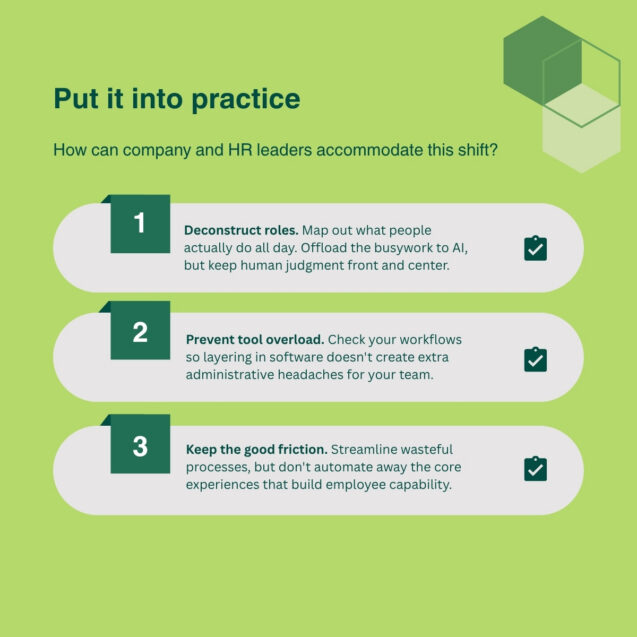 As HR leaders map out workforce strategies, treating a job as a fixed block is a recipe for operational congestion. A job is just a bundle of tasks, decisions, relationships, routines and responsibilities packaged under a single title. “AI may not change a job all at once, but it can change 10 parts of that job very quickly. And if those parts change, the job changes — not always through elimination; more often through reshaping,” Rencher said. “The work moves, the expectations rise, the skill profile shifts and the role evolves. But if leaders keep managing the role as though nothing underneath it has changed, people will feel the mismatch.”
Rencher pointed to an industrial parallel known as the dynamo effect. When electricity replaced steam power, early factory owners simply swapped the power source while keeping vertical, multistory layouts designed around steam belts. Productivity remained stagnant for years. Gains only materialized when factories were redesigned around what electricity actually made possible.
“If we describe this only as an adoption problem, we will prescribe the wrong solution,” Rencher emphasized. “The deeper issue is that [with AI] we changed the inputs without redesigning the work. We layered new tools onto old systems, and that’s why this moment feels so strange.”
Sinek reinforced that technological capability without human system design creates chaos: “It happens every single time: Technologists forget about the people because they become enamored with the technology.”
The primary leadership task is building systems that give new technology room to function effectively.
AI assisted with this article; SmartBrief editor Diane Harrington, who attended the SHRM conference, handled the reporting, direction and last-touch editing.
Opinions expressed by SmartBrief contributors are their own.
Subscribe to SmartBrief’s FREE email newsletter on leadership. It’s among SmartBrief’s more than 250 industry-focused newsletters.