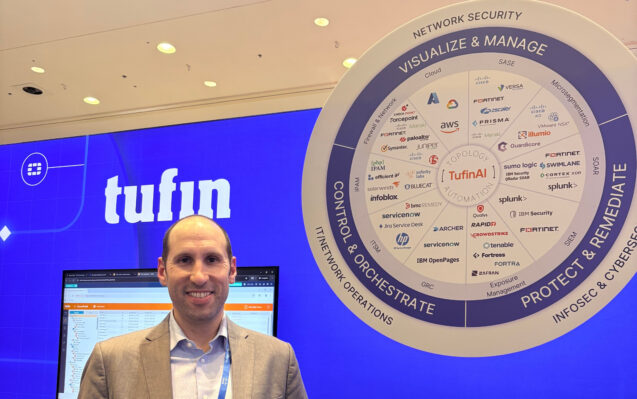
At RSAC 2026, network security and AI agents were top of mind for many exhibitors and attendees alike. “Why AI agents?” “What work should AI agents be tasked with on the network?” “What human oversight is needed?” were just a few of the questions swirling around the event. To get some answers, SmartBrief sat down with Erez Tadmor, CTO at Tufin, a network security policy management platform provider, to discuss the company’s focus on automated compliance for complex regulatory mandates, robust network security posture management to ensure policy intent and the integration of agentic AI to drive operational efficiency. Tadmor also detailed Tufin’s new Multi-Vendor Agentic Network Security offering.
Tufin is moving more toward agentic network security. How do IT leaders and people on the ground ensure autonomous agents stay within defined security boundaries?
Tadmor: This is a great question. The two questions we get most frequently when customers visit our booth: 1) What are you doing around agentic AI? 2) How do you secure it?
Tufin has more than 1,500 customers, mostly Fortune 2000, and we help manage and secure their networks. We work with them to develop automation playbooks that outline the guardrails they should follow when making changes to their networks. And now, with AI entering the field, we see more and more customers and organizations have an appetite to use AI to increase the velocity and agility of how their teams operate. So it’s very important to keep these AI agents within the same playbooks that have been tested, trusted and proven by Tufin and its customers.
We already released a few AI agents that are still in beta. The first is our Compliance Agent. Compliance is a serious challenge for large organizations, and with AI starting to drive more and more changes, the network posture becomes more dynamic than ever before. Organizations are moving increasingly toward continuous validation of compliance vs. point-in-time audits. AI agents are a great way to go and govern that, because they can work at scale. They can work in the velocity that humans cannot. The Compliance Agent can focus on a compliance framework of choice and scan designated networks – no matter where they reside. It can scan network devices to make sure that they comply within a that benchmark of choice – continuously. We train our agents to go and understand compliance, whether it’s corporate compliance or regulatory like PCI, HIPAA, NIST, etc. Agents do the scans continuously, identify where there are gaps, and then you can ask the agent to recommend what to do in order to fix the problems – and later down the road even do the fix themselves. This Compliance Agent is still in beta, but we have more than a handful of customers already testing it.
A second agent we have introduced is the Network Security Posture Agent, which help organizations prioritize vulnerabilities based on real network exposure, attack paths and critical assets. One of the major challenges organizations face today is the presence of siloes within the organization. Security teams and network teams usually have different incentives and goals. Network teams are all about uptime; they need to make sure that the network is always connected and applications are working seamlessly. That downtime is minimal. While the security team is more focused on how to prevent the next breach, and that the organization is fully secured all the time. To qualify that, security often needs data from the network in order to make their job better, faster and more accurate.
For example, a security engineer discovers a vulnerability or an asset deemed vulnerable; one of the things organization engineers would like to know about that vulnerability is whether it is actually accessible from the network. If it is actually exploitable. So, an AI agent that handles posture could work with a security or SOC analyst to gather information from the network and determine whether a certain vulnerability is actually accessible or not. But the agent doesn’t stop there; they could also help with network-level remediation. The engineer could ask the agent: “Hey, can you help me block the connectivity to the accessible vulnerable asset until we are able to patch it?” because patching isn’t always readily available. The agent will then open a ticket within using our network change playbooks to securely go and understand what needs to happen inside the network in order to block your connectivity. And of course, our agent is always human-on-the-loop. So anything that the agent is doing, an engineer will be able to see and approve. This is a very early-stage agent, but this is where we see organizations are going and looking for resolution.
We have two more agents that we’re talking about here at RSAC. The Application Deployment Agent, which defines application connectivity requirements, validates them against policy and helps deploy in-compliant network access. And our fourth new agent is the Policy Recertification Agent, which maps rules to owners, requests approval and helps eliminate unnecessary access.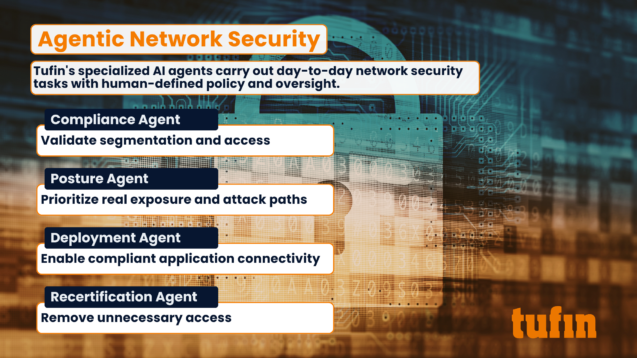
How does Tufin help IT leaders map and control AI agents across the network?
Tadmor: By developing these agents, we make sure they are trained on Tufin’s proprietary data and on years of experience managing network policies. We also continuously validate that they operate as intended, following the trusted playbooks we have developed with our customers over the years.
This is one of Tufin’s core advantages. Many companies are beginning to talk about AI agents in network security, but the issue is not whether an agent can make a change. It’s whether it can make the right change, in the right context, and within the right guardrails. An agent without sufficient context can take actions outside the intended scope.
Tufin acts as a control plane across the environment, with visibility into all relevant devices and the broader network context. That global understanding is what allows us to help ensure AI agents operate safely, consistently and in line with policy.
What do you think the biggest misconception is out there about AI agents and the network?
Tadmor: I think the biggest misconception is that the network is already under control and adequately protected. AI is going to change that equation, because it will operate at a speed and scale we have not seen before.
The network will need to keep pace with increasingly rapid change, much of it driven by application teams already using AI to accelerate development. Those teams will not be able to wait for traditional, manual network processes to catch up. As a result, the network itself will need to become more automated and more intelligent in order to support that level of velocity.
That also means we are going to see far more frequent changes and revisions across the network. The misconception is that this domain is already fully governed and under control. In practice, we often see the opposite. When customers connect Tufin to their network access controls, they often discover legacy rules or unnecessary access they were not fully aware of. For example, they may find a rule allowing traffic into a sensitive database and ask: Why does this rule still exist? Who needs it? Was it created for a temporary request months ago and never removed?
That kind of issue already exists today, and AI without the right guardrails can accelerate the same problem. If it is not operating with the right context, policy controls and oversight, it can make broad or unnecessary changes simply because that is the fastest path.
So the real misconception is that the network is a solved problem. It is not. And as AI increases the pace of change, organizations will need to pay much closer attention to network posture, governance and control.
Looking at the trends and the threats that are being discussed at RSAC. What do you think is going to be shaping network strategy and security strategy over the next several years?
Tadmor: How do you make sure that AI, agentic AI specifically, but not just a genetic AI, any type of AI that runs in the network, is doing and playing as it intended to do so, setting up the right guardrails, setting up the right playbooks for AI agents to utilize? I think this is one of the major things that security will need to put a lot of attention since it’s a matter of trust.
We see lots of organizations that have an appetite for using AI in their networks, but they have zero appetite for letting AI do things without trusting it or knowing what the end result will be.
We see lots of our customers running AI in their lab environments in order to test it, in order to learn better what could be accomplished and what are the risks.
Ultimately, this comes down to trust. The key question is how organizations can apply the zero-trust principles they already rely on in an environment that now moves at machine speed. I believe that will be one of the defining security topics in the years ahead.
If you like these insights, sign up for the ISACA SmartBrief on Cybersecurity, a daily look at the top news and workforce education topics.