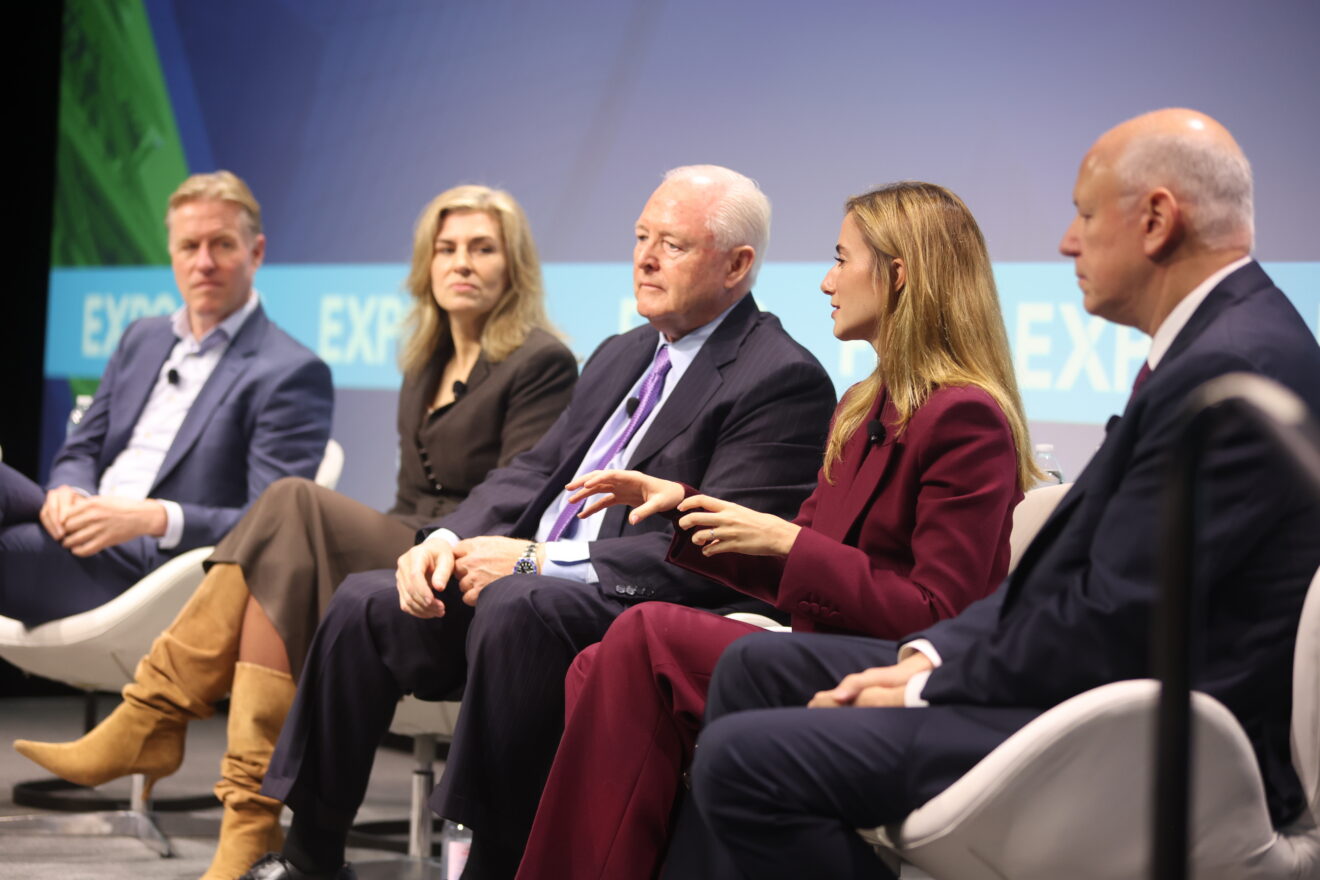
Leaders from the top exchanges gathered at FIA’s Futures & Options Expo for a wide-ranging discussion on where the derivatives industry is headed, potential regulatory changes, energy, innovation and evolving business models.
Eurex CEO Robbert Booij, CME Group President and CFO Lynne Fitzpatrick, MIAX CEO Thomas Gallagher, Kalshi COO Luana Lopes Lara and Intercontinental Exchange Chair and CEO Jeff Sprecher came together for a conversation moderated by Semafor Business and Finance Editor Liz Hoffman. Some of the highlights included:
Retail and institutions: complementary, not competing
Sprecher pointed to equities as the model for how retail and institutional markets can coexist in events contracts. Zero-commission brokers, starting with Robinhood, dramatically expanded retail participation during COVID, yet little retail flow reaches the New York Stock Exchange and little institutional flow sits in payment-for-order-flow venues. The two sides are highly correlated, and together they make the US equity market bigger, deeper and more liquid. Futures and newer products, Sprecher suggested, may follow the same path.
Kalshi’s Lopes Lara said the company wants to build prediction markets liquid enough to work for institutions. “Our dream is really how do we do prediction markets that are liquid enough that it actually works for institutions, and I think there are a lot of different building blocks to get there,” she said. “The last one we really see is getting margin trading in prediction markets, which is something we’re working on with regulators. For sure, our goal is more institutional.”
Asked whether Kalshi can do that without giving up retail, Lopes Lara said, “It’s actually easier than it seems because the core of the business ends up the same,” and described the two use cases as additive. Lopes Lara was open about Kalshi’s ambition: “The dream is to one day be as big as ICE… institutional is a very big focus for the business right now.”
Prediction market regulation and the Supreme Court
The sharpest exchanges came over prediction markets and the pending Supreme Court question over whether oversight could shift back to the states. “To start, we think we are going to win,” Lopes Lara said.
If regulation moves to the states, Lopes Lara suggested many would be happy to work with prediction markets, and North Carolina’s approach to taxes and customer protection could serve as a model. “I think a lot of states would take that path, but we’ll see what we get there,” she said. States would want to work with Kalshi and the company has no problem paying tax, Lopes Lara said, but added that the exchanges are federally regulated because that’s the only way that prediction markets can work and have liquidity and fulfill their potential.
Fitzpatrick said for CME, a major concern is whether a listed contract meets regulatory requirements, such as not being readily susceptible to manipulation, and whether it provides economic benefit to users. She stressed the industry’s reputation is important and said she wants to avoid chipping away at it as exchanges move into new areas.
“We’ve built a brand and reputation that we want to protect,” she said.
Other key topics included:
Weekend liquidity challenges. Fitzpatrick said the industry is moving toward 24/7 trading, but institutional products on weekends face a basic obstacle: without full access to the banking system and the ability to move money at size and scale, as is done during the week, it is hard to offer them.
Smaller contracts, tighter rules in Europe. Booij said Europe lags the US on retail. “From a retail perspective, obviously we are somewhat behind in terms of the US,” he said. Eurex is focused on smaller mini contracts and shorter durations, with a trend toward trading financial products.
Compute futures. On compute futures, Sprecher cautioned against underestimating the other inputs that make AI work. Memory, he noted, used to be practically given away and is now sky-high, and it’s an open question whether prices will fall again. He also wondered whether compute could ever reach the public awareness of something like oil. “You and I will never buy a barrel of oil, but we look at it on TV. It resonates with us.”