Welcome to The Month in Infrastructure, a new monthly recap of the top trends affecting the built environment and the people who work in it.
Across energy, construction and water systems, there was a consistent underlying theme in March: The buildout of AI infrastructure has become so fast and so voracious that the traditional systems built to support people are struggling to keep up. Here’s what moved the needle.
Data centers declare independence
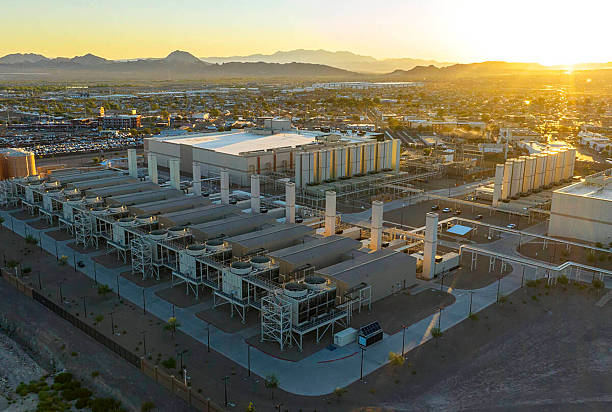
The most significant development in March was a shift that engineers and utility analysts have been quietly dreading: Data centers are beginning to go grid-optional. AI model training and inference workloads demand consistent, uninterrupted and massive amounts of power. Utility grids, constrained by aging transmission infrastructure and years of underinvestment, simply cannot respond fast enough. The result is that hyperscalers and colocation operators are increasingly bypassing the grid entirely, building 800-volt DC power architectures within their facilities that eliminate the need for traditional AC transmission infrastructure altogether.
In data center hubs like Texas and Northern Virginia, large operators are effectively functioning as their own micro-utilities by managing onsite generation, distribution and load balancing without meaningful dependence on the regional grid. When large commercial and industrial customers representing hundreds of megawatts of load defect to self-generation, utilities face a “death spiral” scenario where the high-volume customers who subsidize grid maintenance costs disappear, forcing per-unit rate increases on remaining ratepayers, which in turn accelerates further defection.
The vendor ecosystem is adapting accordingly. Industrial power and equipment manufacturers are pivoting toward what might be called “sovereign power” solutions: Onsite gas turbines, small modular reactors and fuel cell systems sold directly to hyperscale tech companies. Engineering and design firms, meanwhile, face the technical challenge of rethinking their entire design vocabulary. Traditional substation layouts and AC distribution schematics give way to DC-native, thermally optimized environments built for 800V operation. The knowledge base required is substantially different and firms that don’t build that capability quickly will find themselves on the wrong side of a rapidly bifurcating market.
On the software and orchestration side, a new lane is opening for enterprise technology and consulting providers: energy resource planning for tech companies that now own and operate their own power infrastructure. Managing distributed generation assets, fuel procurement, backup capacity and power quality at the scale of a small utility requires enterprise-grade software and implementation expertise, and the incumbents in both categories are well-positioned to deliver it.
Energy realism
The second energy trend of March is more political than technical. After years of aggressive decarbonization rhetoric from state governments, a growing number of blue-state governors publicly backed natural gas investment as the only viable short-term answer to surging electricity demand. The federal government reinforced this pivot with a broad permit overhaul designed to accelerate approvals for pipelines, gas-fired generation and associated infrastructure.
Moreover, the electricity demand surge driven by AI data centers and domestic manufacturing reshoring has exposed a fundamental tension in the energy transition. Intermittent renewable sources, however economical and increasingly abundant, cannot alone satisfy the around-the-clock, weather-independent power demands of the digital economy. Grid operators in high-stress regions are sounding reliability alarms and political leaders, regardless of their long-term climate commitments, are unwilling to preside over blackouts or industrial-scale energy rationing.
The permit overhaul effectively creates a development gold rush for midstream and upstream energy operators. Projects that had been in regulatory purgatory are suddenly viable. For legal and financial advisory firms, this means a surge in M&A activity, project financing and regulatory work as developers race to capitalize on the new permitting environment. For utilities and generators, the question is how to maintain credible commitments to long-term clean energy goals while simultaneously building out the gas infrastructure the near-term demand picture demands. It’s a genuinely difficult balancing act, and March’s headlines suggest most operators are simply choosing to hold both tracks simultaneously rather than resolve the tension.
The hidden costs of data center growth
In the broader infrastructure conversation, March headlines suggest a pivot in how the industry and local government are thinking about the data center boom.
As data centers have grown into multibillion-dollar facilities housing irreplaceable compute infrastructure, the insurance market has struggled to keep up. Coverage gaps for construction-phase risks and operational hazards are widening and insurers are increasingly reluctant to underwrite projects without demonstrated risk management protocols.
Another pressure point is the community relationship. Local governments that have spent years competing aggressively for data center investment by offering substantial tax abatements and fast-tracked permitting are beginning to reassess the trade-off. Data centers consume enormous quantities of power and water while creating relatively few permanent jobs. The transparency requirements and infrastructure-sharing mandates now appearing in new data center agreements across multiple jurisdictions reflect a growing municipal demand for genuine community benefit, not just ribbon-cutting photo opportunities. For cloud and hyperscale operators, this shifts the required messaging from speed-to-market to sustainable growth.
On the design side, the water consumption question is driving real engineering innovation. There is surging demand for dry cooling and closed-loop water systems that allow data centers to operate in water-stressed regions without drawing from already-strained municipal supply.
Water affordability crisis
Coverage of water infrastructure stories in March told a story about a system quietly buckling under its own deferred costs. Water infrastructure like pipes, treatment systems and pump stations is aging faster than municipalities can replace it. The numbers behind that gap are stark: Some organizations estimate the US faces a water infrastructure funding shortfall in the trillions over the coming decades. Rate increases meant to close that gap are hitting residents and small businesses hard, particularly in lower-income communities where water bills have become a genuine household burden. The political pressure to keep rates affordable collides directly with the financial reality of maintaining systems that were built generations ago and are now failing with increasing frequency.
Asset management maturity, through use of sensor data, predictive analytics and digital twin technology to extend the functional life of existing infrastructure, is becoming the dominant strategy for utilities that cannot afford to replace what they have, let alone build for future demand. It is a strategy born of constraint rather than ambition. Water has become unaffordable to fix and increasingly unaffordable to deliver. March’s headlines made clear the industry is only beginning to reckon with both halves of that problem.
________________________________________________________________________________________
For more insight like this, subscribe to one or more of SmartBrief’s newsletters covering the built environment, the energy landscape and the public sector.