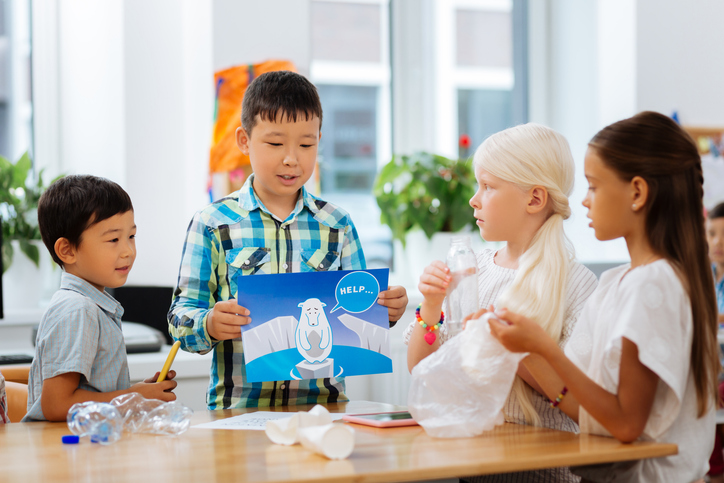
Belonging is the experience of being accepted, valued, connected and able to contribute within a community. In classrooms where students know their voices matter, they participate more fully and push through difficulty. This makes belonging a core condition for learning, not an add-on — especially for multilingual learners who may feel more disconnected than their peers.
Yet, as districts work to improve outcomes for multilingual learners, much of the conversation centers on curriculum, assessments and compliance. But even the best curriculum can’t accelerate learning if multilingual learners aren’t positioned to belong inside core instruction — where relationships, identity and grade-level thinking are built.
Brandon Cardet-Hernandez, the CEO of Medley Learning, adviser to Harmony Academy at National University, argues that something more foundational is at play.
We talked with the former turnaround principal and advocate for multilingual learners about why belonging should not be just a “nice to have” — and why leaders must intentionally design systems that protect participation and rigor for multilingual learners.
Creating belonging for multilingual students is not about making learning easier.
It’s about making learning accessible.
— Brandon Cardet-Hernandez
Question: Many districts are focused on accelerating learning for multilingual learners. Why are you emphasizing belonging?
Answer: Building belonging is not separate from instruction. In fact, it is the condition that makes learning possible.
Belonging isn’t just how students feel — it’s what the classroom lets them do. Belonging shows up in who gets to talk, who gets to grapple with complex text and who gets seen as a thinker. When multilingual learners are on the margins — silent, pulled out or given easier work — they don’t just miss content; they miss the daily experience of being a full member of the learning community.
Multilingual learners are often learning content, language and culture simultaneously. That’s an enormous cognitive and emotional lift. When students feel socially safe and valued, they are more willing to take the intellectual and linguistic risks that are essential for language development. That’s why a critical path to belonging is often instructional: designing lessons so multilingual learners can participate in the same grade-level work as their peers, with supports that make rigor accessible.
In classrooms designed for connection, multilingual learners participate more, persist through difficulty and accelerate in both language and learning.
Q: What are effective approaches to building connections among peers for multilingual learners?
A: For multilingual learners, student-to-student connections are especially powerful because they lower anxiety and build confidence across language differences.
One approach we recommend is what we call “low-stakes, high-joy” teaming. Before asking students to engage in complex academic discussion, create playful, structured collaboration: scavenger hunts, building challenges or partner activities with defined roles like “builder,” “clarifier” and “encourager.”
Each student has a communication goal. For example, “Ask one question” or “Give one suggestion.” Teachers provide sentence frames such as “What if we …?” or “Do you mean …?” and allow 10 seconds of rehearsal before sharing.
These predictable routines, like the Quick Connection Cards in Harmony Classroom Kits, reduce fear of making mistakes. Students experience success speaking in smaller settings before moving into whole-group discussions.
Schools need to give multilingual learners clear entry points like these to open up conversations and break down barriers.
The goal is to marry social connection and academic contribution — so students don’t just feel included, they’re actively building meaning with peers during real grade-level tasks. That means structured talk in core instruction: roles, sentence frames, visual supports, and predictable routines that ensure every multilingual learner has a way in.
Q: What’s the most common mistake in schools trying to support belonging for multilingual learners?
A: The most common mistake is lowering expectations. A close second is separating multilingual learners from grade-level peers, which reduces the interaction and shared experience that drives language growth. Too often, multilingual learners are given watered-down assignments, below-grade-level materials or texts that feel developmentally too young. That may seem helpful in the short term, but it sends a powerful message about what we believe students are capable of.
Creating belonging for multilingual students is not about making learning easier. It’s about making learning accessible.
Access is the right of every student. Multilingual learners must have the chance to meaningfully participate with grade-level content. If we lower expectations, students disengage.
Q: What is one leadership move districts can make right now?
A: Start by looking at how your system functions. Ask yourself simple questions, and be honest about your answers.
- In classrooms, who is talking, and who is mostly observing?
- Where do multilingual learners have protected opportunities to speak, write and reason about grade-level content every day — and where are they routinely spectators?
- Are multilingual learners consistently present in the spaces where relationships are built, or are they routinely separated in the name of support?
- Do teachers have the time and structures to plan for language development inside grade-level instruction, or is that responsibility isolated to one department?
- Do we have the digital tools to free up time for our educators to build the relationships that drive connections?
Belonging requires shared responsibility across adults and systems so that multilingual learners are not only included, but heard. When leaders intentionally design for participation and protect access to learning, language growth follows.
Brandon Cardet-Hernandez is the CEO of Medley Learning, an AI-powered tool to support multilingual learners with on-demand scaffolds. He partners with districts nationwide to expand access to grade-level content and accelerate language development for multilingual learners. He is a former New York City Public Schools teacher and principal who later served as Senior Education Advisor to Mayor Bill DeBlasio. He works with Harmony Academy at National University to help schools and districts turn belonging into measurable gains in engagement, attendance, teacher retention and academic success.
Opinions expressed by SmartBrief contributors are their own.