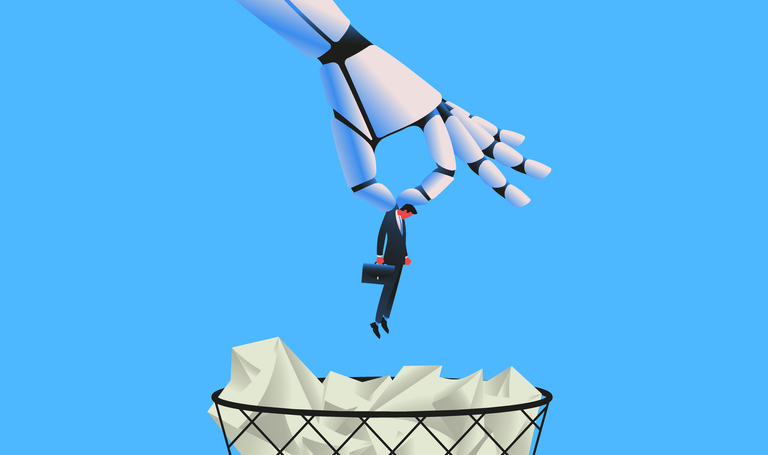
Not long ago, newsfeeds were dominated by fears of automation replacing jobs. Before that, the panic was about globalization erasing industries. Now, AI has become the next existential threat in the minds of many leaders. Yet, when viewed through the lens of biology and the ecosystems we inhabit, panic is almost never the most adaptive response.
In healthy ecosystems, biotic actors (living organisms) coexist and compete with abiotic factors (non-living forces ) like climate, terrain or chemical composition of the environment. AI is not a predator. It is simply an abiotic factor. What makes it unsettling for some is that it mines and mimics human behavior, which challenges our sense of what is distinctly “ours.” But biology teaches us that when environments change, those who thrive are the ones who remain highly attuned to their sensory inputs and adapt their behaviors accordingly.
The sensory shortcut and why panic disables it
In the biology of behavior, sensory systems are the entry points for adaptive action. Whether it’s a gazelle spotting movement in the grass or a leader sensing a shift in market sentiment, the first step toward a productive response is noticing. In ecosystems, ignoring sensory data is a fast track to extinction.
Panic, however, is the neurological equivalent of tunnel vision. It floods the system with cortisol, narrows attention and biases decision-making toward immediate, often defensive, action. Leaders gripped by AI panic stop noticing subtler cues like the early signs of opportunity, the weak signals of emerging partnerships or the nuanced feedback from their teams. Instead, they rely on secondhand interpretations of risk, often from sensational headlines or speculative forecasts.
When leaders outsource their sense-making to fear or to those selling panic, they’re effectively blinding themselves to the signals that matter most in adapting to a new environment.
Lessons from evolutionary adaptation
In evolutionary terms, species that survive environmental disruptions tend to follow three patterns:
- Exploit new niches: When volcanic eruptions create new land, certain plants are first to colonize the soil.
- Develop symbioses: Organisms often partner with others to adapt to new constraints or access new resources.
- Shift behavior before structure: Behavioral plasticity, the ability to change behavior without changing underlying biology, is often the first line of adaptation.
Leaders facing the rise of AI can borrow from each of these strategies. New niches are emerging in AI oversight, human-AI collaboration and ethical governance. Symbioses are forming between organizations and AI providers, combining computational scale with human judgment. And behavioral shifts, like learning to prompt AI effectively or integrating AI outputs into decision-making, are possible without overhauling entire systems overnight.
How panic erodes behavioral plasticity
Behavioral plasticity depends on accurate perception and clear signaling. In my Biohacking Leadership framework, I focus on warmth, competence and gravitas as the three behavioral “channels” that leaders can dial up or down to fit the situation. Panic distorts all three.
- Warmth suffers because fear-driven leaders tend to pull inward, reducing trust-building interactions.
- Competence appears shaky when decisions are made reactively rather than strategically.
- Gravitas, in my definition, the ability to bring people together to create shared value, evaporates when leaders are broadcasting uncertainty instead of stability.
The biology of behavior shows that confidence signals are often reciprocal. If you stop sending them, others stop sending them back. In ecosystems, this feedback loop can shift an entire community from cooperative to defensive mode, precisely the wrong posture for leveraging a disruptive new factor.
Reframing AI as an abiotic factor
When we label AI as a mere abiotic factor, we remove the predator-prey dynamic that fuels panic. AI is not hunting us. It is, however, reshaping the terrain. In a forest, a new river can be a barrier or a resource depending on whether you fixate on what you’ve lost or on how you might cross it. Leaders who treat AI as an environmental change rather than an existential threat open themselves to strategic experimentation.
What makes AI unusual is its ability to mimic the outputs of biotic actors: art, strategy, language. But ecosystems already offer analogues. Cuckoo birds mimic the calls of other species to infiltrate nests. Orchids mimic the pheromones of insects to attract pollinators. Mimicry is not new. The question is not “how do we stop it?” but “how do we evolve our behaviors in response?”
Sensing opportunities before others do
Adaptive leaders in any era share one habit: they invest in sensory awareness. They seek first-hand data, ground-level perspectives and diverse inputs. In biological terms, they expand their “sensory perimeter.” For AI, this might mean:
Experimenting with AI tools to understand their real capabilities and limitations.
- Observing how competitors are integrating AI, and where they’re struggling.
- Listening for internal signals from employees about where AI helps and where it hinders.
These leaders don’t abandon their senses in favor of sweeping narratives. They use those narratives as one input, not the only one.
The biohacker’s advantage
In biohacking leadership, the goal is to optimize biological systems, our own and those of our organizations, for impact. That starts with awareness: of our physiological states, our behavioral signals, and our strategic environment. AI panic trains leaders to skip this step and go straight to reaction. The biohacker resists this shortcut, staying rooted in observation, experimentation and iteration.
Think of it as tuning the ecosystem’s “behavioral channels” rather than abandoning them. Warmth to keep teams engaged and collaborative in uncertainty. Competence to demonstrate mastery of both human and AI tools. Gravitas to hold a steady center while the terrain shifts.
From panic to pattern recognition
Ecosystems reward pattern recognition over panic. Leaders who keep their senses open can spot not only threats but also inflection points, those moments when the environment is most malleable. AI is such a moment. The terrain is still forming. The winners will be those who can read the weak signals and adjust before the patterns are obvious to everyone else.
The biology of behavior doesn’t promise a smooth transition. It promises that those who sense and adapt fastest will shape what comes next. AI is not a predator at the gate. It is a change in the weather. Leaders who train themselves to feel the wind, watch the clouds and plan accordingly will do more than survive. They will thrive.
Opinions expressed by SmartBrief contributors are their own.
____________________________________
Take advantage of SmartBrief’s FREE email newsletters on leadership and business transformation, among the company’s more than 250 industry-focused newsletters.