
Every August, I find myself thinking about a young teacher I met early in my career as a mentor, before I became an instructional coach or administrator. He had accepted his first teaching position several hours from home, leaving behind his family, his friends and everything familiar.
Like many first-year teachers, he wanted to prove he belonged. He arrived before sunrise, stayed long after students had gone home, and spent countless evenings revising lessons that were already good because he wanted them to be even better. Teaching was more than a job to him. He genuinely wanted to make a difference.
Unfortunately, he began his career in a school where encouragement was difficult to find. The principal led through criticism rather than relationships. Expectations were high, but support was scarce. Teachers often left conversations feeling defeated instead of encouraged. For a beginning teacher trying to find his footing, every piece of criticism carried tremendous weight.
Over time, I watched his confidence begin to erode. The excitement that had filled those first weeks slowly gave way to self-doubt. Every observation felt critical. Every lesson that didn’t go exactly as planned became another reason to wonder if he had chosen the wrong profession. One afternoon, after students had left for the day, he stopped by my classroom. He sat quietly before asking a question that has stayed with me for years.
“Do you think I’m cut out for this?”
A lesson in hope
I don’t remember every word we exchanged that afternoon, but I remember what I wanted him to hear. I believed in him.
Looking back, I realize that conversation wasn’t really about lesson planning or instructional strategies. It was about hope. He needed someone to remind him that struggling didn’t mean he was failing. He needed someone who could see what he couldn’t yet see in himself.
That experience changed the way I think about mentoring. Schools spend a great deal of time helping new teachers learn procedures, technology, schedules and expectations. Those responsibilities matter, but they aren’t what beginning teachers remember years later.
They remember who checked on them after a difficult day. They remember who celebrated a lesson that finally clicked. They remember who reminded them that every accomplished teacher was once a beginner.
The first 30 days of mentoring are about far more than helping someone learn a new school. They are about helping someone believe they belong there.
As mentors, it’s tempting to jump immediately into coaching. We notice classroom management issues, instructional opportunities and dozens of ideas we want to share. Our experience tells us exactly what we would do.
Resist that temptation. Relationships come before recommendations.
Relationships build trust
Before discussing instructional strategies, spend time getting to know the person. Ask why they became a teacher. Ask what excites them. Ask what has surprised them. Ask what keeps them awake at night. Then listen carefully. The quality of your mentoring will always be connected to the quality of your relationship. Building trusting relationships isn’t accidental. It requires intentional conversations, genuine curiosity, and a strengths-based approach.
Beginning teachers also need someone who notices what is going right. Most of them spend a lot of time replaying their mistakes. They don’t need empty praise, but they do need someone who points out genuine strengths.
Specific encouragement matters. Saying “You handled that transition calmly” or “I noticed how every student felt comfortable answering your question” helps new teachers recognize practices worth repeating. Confidence grows when people see evidence that they are improving.
Mentors also serve beginning teachers well by asking more questions than they answer. Rather than solving every problem, ask, “What do you think happened?” “What surprised you?” “What might you try tomorrow?” Reflective questions help teachers develop professional judgment rather than relying on someone else’s answers.
Those reflective conversations don’t happen by accident. They are most effective when mentors approach them with curiosity rather than quick solutions. Helping teachers think more deeply about their own practice begins with thoughtful questions that invite reflection rather than rushing to offer advice.
Another responsibility of a mentor is giving new teachers permission to struggle.
Learning from failure
Too often, veteran teachers unintentionally create the impression that they have always known what they were doing. We haven’t. We’ve all taught lessons that fell flat. We’ve all questioned ourselves. Sharing those stories honestly reminds beginning teachers that growth has always been part of teaching.
A few years after that young teacher started his career, he admitted there had been a time when he seriously considered leaving education. Hearing those words still gives me pause. Students would have lost an extraordinary teacher.
Thankfully, he stayed.
Today, 20+ years later, he is exactly the teacher his students deserve. His classroom is filled with laughter, curiosity and relationships. Families trust him. Students know they are cared for. He changes lives every day, and I am grateful to call him not only a former colleague but also one of my closest lifelong friends.
Whenever I think about mentoring, I think about him. Not because I believe I made him into the teacher he became. His perseverance, work ethic, and commitment to students made that possible. But I do believe every beginning teacher deserves someone who believes in them before they fully believe in themselves.
The first 30 days will never determine whether a new teacher has mastered the profession. None of us does that in a month. They can, however, determine whether a beginning teacher walks into October with enough confidence to keep growing.
Sometimes, belief is the greatest gift a mentor can give. Sometimes, it is the reason an outstanding teacher stays in a profession that desperately needs them.
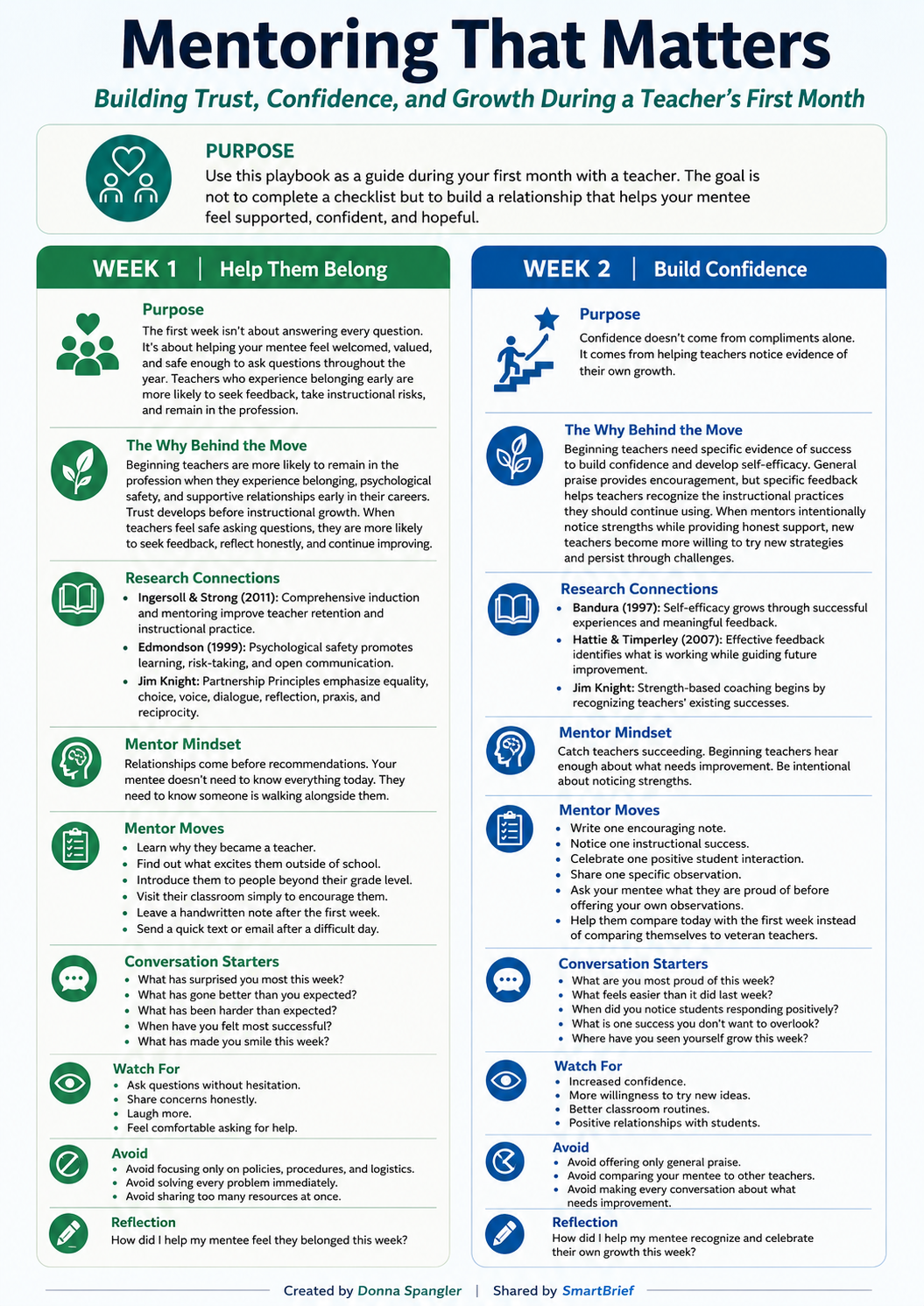
If you’re mentoring a teacher, formally or informally, this year, I’ve created a Mentor First 30 Days Playbook for weeks 1 & 2 and weeks 3 & 4, with conversation starters, weekly priorities, reflection prompts, and celebration ideas you can use during those early weeks together.

Opinions expressed by SmartBrief contributors are their own.
Subscribe to SmartBrief’s FREE email newsletters to see the latest hot topics on educational leadership. They’re among SmartBrief’s more than 200 industry-focused newsletters.