This article originally appeared in SmartBrief’s eBook “The Shift: AI — How foodservice is adapting to a new era of intelligence.” Read the full eBook.
AI may operate quietly behind the scenes, but its impact on restaurant labor, training and culture is already beginning to reshape how kitchens function – and how teams work together. As operators continue to navigate labor shortages, rising costs and employee turnover, many are turning to AI to automate repetitive administrative work, improve staffing decisions and streamline onboarding.
According to the National Restaurant Association’s recent Hiring & Staffing: How Onboarding, Managers & Technology Drive Restaurant ROI report, restaurant managers spend substantial time on scheduling, hiring coordination and onboarding — areas increasingly being supported by AI-powered systems.
As of February 2026, 26% of restaurant operators reported using AI-related tools, according to the National Restaurant Association.
“We’ve seen these tools dramatically accelerate the hiring process, reducing understaffing and freeing managers to focus on what they were hired to do – running their restaurants,” said Chad Moutray, chief economist for the National Restaurant Association.
For operators, the appeal is increasingly practical rather than experimental.
“In general, I am super excited over AI and its applications,” said Judy Joo, Korean-American chef, restaurateur and television personality. “When I look at an AI tool, I’m asking: Does it solve a real bottleneck, eliminate time-consuming tasks or improve efficiency? What happens when it’s wrong, and does it give my team back time with the guest?”
Rethinking training and onboarding
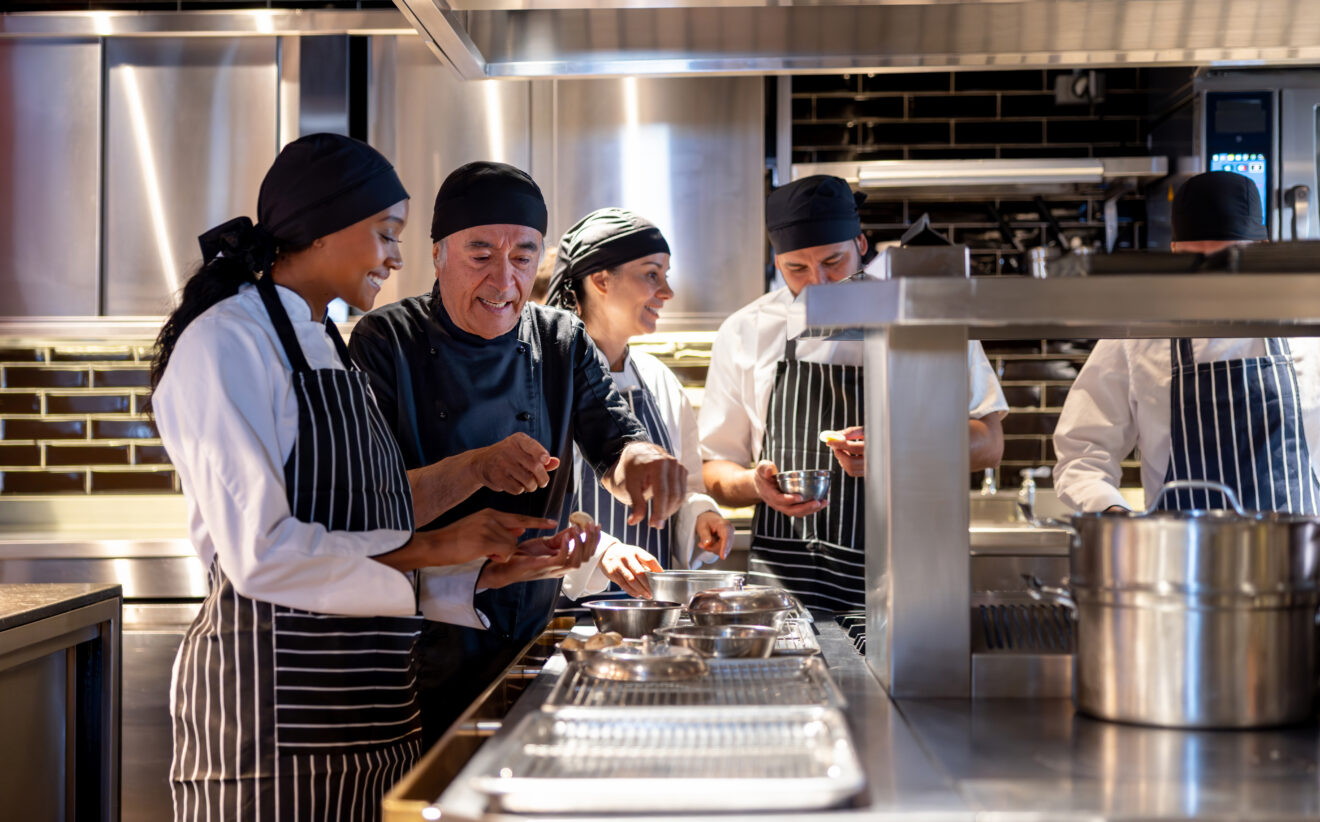
Training has long been one of the restaurant industry’s most persistent operational challenges. High turnover, limited manager bandwidth and compressed onboarding timelines often force operators into inconsistent training practices that vary significantly by location and shift.
The National Restaurant Association’s staffing research found that strong onboarding and manager support directly influence retention and employee engagement, particularly among hourly workers. Yet many operators continue to struggle with maintaining consistency across locations while balancing labor pressures.
“One of the biggest gaps I’ve seen in traditional training is that it often prioritizes repetition over understanding,” said Adrianne Calvo, award-winning Miami-based restaurateur, best-selling cookbook author, Emmy-nominated YouTube show host, podcaster and founder of Chef Adrianne’s Vineyard Restaurant and Bar. “We train people on what to do, but not always why it matters. In a high-performance restaurant, that distinction is everything because true excellence comes from instinct, not memorization.”
AI-powered training systems are increasingly being positioned as a solution to that inconsistency. Many platforms can adapt training modules to individual learning speeds, identify knowledge gaps in real time and deliver scenario-based coaching designed to reinforce decision-making under pressure.
Today’s AI-driven training platforms can:
- Adapt to individual learning speeds and styles
- Identify skill gaps in real time
- Deliver interactive modules, quizzes and simulations
- Provide virtual coaching through chatbots
- Track performance across locations for consistency
For multi-unit operators, this consistency is especially critical. AI can ensure that a new hire in one location is trained to the same standard as another across the country, reducing variability in both food quality and guest experience.
“AI has the potential to bridge that gap beautifully,” Calvo explained. “It can create dynamic, adaptive training systems that respond to how someone learns and reinforce knowledge in real time, and even simulate high-pressure scenarios before someone ever steps onto the floor. That’s powerful.”
Industry data supports the growing role of AI in training. The Hospitality Training 360 Report 2025 found that 72% of restaurant learning and development professionals say AI has improved work quality, even as the time spent on ongoing training for hourly employees continues to shrink.
Still, Calvo and Joo both cautioned against overreliance.
“What AI can’t teach is the feel of the room, the polite, friendly customer interaction that’s professional and not invasive, elegant conflict resolution and emotional intelligence – when to approach a table and when to disappear. That still takes a mentor and experience,” Joo said.

Smarter scheduling for a balanced workforce
Beyond onboarding, labor scheduling has emerged as another major area where AI is reshaping operations.
Scheduling remains one of the industry’s most time-intensive management functions, requiring operators to balance labor budgets, employee preferences, compliance requirements and fluctuating customer demand.
Done manually, it’s time-consuming and usually vague. Schedulers find themselves buried in multiple spreadsheets that rely on intuition and best guesses. AI changes that.
Staffing needs can be AI-generated with exceptional accuracy by analyzing various factors such as past sales performance, customer volume, weather conditions and regional events.
This enables operators to:
- Avoid understaffing during peak hours
- Reduce unnecessary labor during slow periods
- Minimize overtime costs
- Distribute shifts more fairly
The operational impact extends beyond labor cost savings alone.
Gallup’s ongoing meta-analysis of workplace culture and business performance has surveyed 64 million employees over 25 years, highlighting the impact of management on employee engagement. The research consistently finds that teams with superior management not only achieve higher engagement but also deliver stronger business outcomes, such as 23% higher profitability, reduced absenteeism, lower turnover and increased customer satisfaction.
For restaurants, where turnover remains one of the industry’s most expensive challenges, reducing manager administrative burden can have a measurable impact on retention and employee engagement.
Joo said the distinction between earlier restaurant technology waves and AI is that AI increasingly performs operational work itself.
“I’ve lived through a few ‘this changes everything’ moments – OpenTable, Toast, delivery apps, ghost kitchens,” Joo said. “They were real, but they mostly digitized transactions that were already happening. AI is the first wave I’ve seen that can actually do work: write a prep list, draft a schedule, flag a cost spike, model a business forecast. That’s an extra pair of hands in an industry where labor has been the hardest constraint for a decade.”
Building trust and protecting hospitality
As AI adoption accelerates, operators are also confronting growing questions around employee trust, transparency and workplace culture.
For Calvo, building that trust starts with clear, proactive communication.
“If your team thinks AI is there to replace them, you’ve already lost them,” she said. “But if they understand it’s there to support them…you create buy-in.”
Joo emphasized that the way AI is introduced can shape how it’s ultimately received by staff, and that involving employees early in the process can help reduce skepticism and improve adoption.
“The conversation has to start differently: ‘We’re doing this to eliminate the parts of your shift that take up too much time’…the menial but necessary tasks like paperwork, repeated inventory counts, equipment checks and scheduling,” she said. “Then bring staff into that process. Let them tell you what’s wearing them down; they’ll know. When that happens, retention should improve, because the job becomes more about what they actually love: hospitality.”
In addition to honesty and inclusion, Gartner encourages organizations to take a flexible, case-by-case approach to AI ethics. Rather than applying rigid rules, companies are advised to monitor systems for fairness, transparency and bias continuously. Gartner also points to the importance of broader industry collaboration in shaping standardized ethical frameworks, efforts that will be key to reinforcing accountability and maintaining trust as AI expands.
As AI takes on more operational decisions, restaurant leaders must be intentional about what remains human.
“A great restaurant leader knows what not to automate,” Calvo stated. “The winners will use AI for efficiency but still trust their instinct, palate and connection to the guest. Hospitality isn’t a transaction – it’s a feeling, and leaders protect that.”