
In a time when families are increasingly fragmented by packed schedules and distracting devices, studies show that the simple act of sharing a meal around the dinner table remains one of the most effective ways to support family members’ physical and mental well-being, overall resilience and even financial stability. For children, shared mealtimes and conversations produce even greater benefits: improved academic performance, stronger social skills and reduced rates of risky behaviors, to name a few.
In short, family mealtime serves as a vital anchor where physical nutrition meets emotional connection.
The Family Meals Movement
In support of the transformative power of family meals, FMI – The Food Industry Association’s Foundation launched National Family Meals Month to spotlight the benefits of gathering together over a meal. Now in its 12th year, the initiative has extended its reach from a monthly endeavor each September to a year-round Family Meals Movement.
“Family meals remain central to the American family,” said David Fikes, executive director of the FMI Foundation, in a recent FMI news briefing. “It’s a practice that shoppers identify positively, and they are making a concerted effort to maintain it.”
In fact, 44% of respondents to a recent FMI study reported having more meals at home last year than in previous years, and over half expect the number of family meals at home to continue to increase. In addition, more than 90% of respondents say they see benefits in family meals, while 66% say the meals are worth the cost and effort they require.
The case for family meals
From stretching household budget to strengthening mental resilience, the returns on investment in regular mealtimes offer a “plethora of benefits,” Fikes said, noting many of those benefits apply whether family is defined by your biological family or if it is comprised of friends and roommates who are a family of your choosing. From the immediate to the life-long, here are seven benefits that make sharing a meal worth the planning and effort.
Economic savings. Half of respondents to a recent FMI survey cite economic savings as one of the major benefits of family meals, indicating that family meals at home help them stretch their food-purchasing dollar.
Lower household stress. A whopping 91% of parents report reduced stress in their households when they share regular family meals, according to research from Aspirus Health. These stress-reducing benefits do not depend on the complexity or formality of the meal, but rather on the routine of gathering together. Even simple meals can create a calmer, more connected home environment, helping parents navigate the hustle of everyday life more effectively.
Improved nutritional intake and overall better health. More than 40 systematic reviews by the National Institute of Health found that more frequent family meals are linked to healthier eating habits, improved nutrition and lower rates of obesity among children and adolescents. Nearly one-third (30%) of respondents in FMI’s survey reported a higher intake of fruits and vegetables as a benefit of family meals.
Development of conflict management skills. According to Aspirus Health Pediatrician Gretchen Karstens, even the “messy” moments at the dinner table have significant value. “Kids learn from all kinds of interactions, whether they are light, serious, tense or peaceful,” Karstens said in a recent statement. “These are key opportunities to really impart how to be in society. Our ability to manage conflict and engage with others in conversation can directly impact how we feel about our own efficacy in groups and socially.” Those skills translate into improved family civility – a benefit noted by 33% of FMI survey respondents.
Better academic performance. According to research conducted by Harvard University behavioral scientists, casual dinner conversations expose young children to roughly seven times as many sophisticated vocabulary words as reading aloud does.
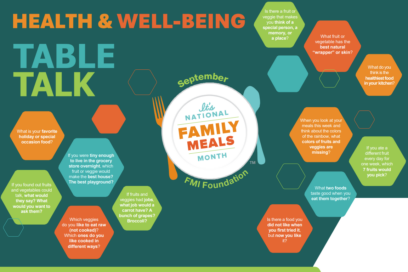
Having trouble getting conversations started? Print some of FMI’s Table Talk Placemats for a wide selection of fun conversation starters. Furthermore, regular mealtimes have been identified as a stronger predictor of high academic achievement in school-aged children than time spent doing homework, playing sports or doing an art project. Long-term studies by the National Center on Addiction and Substance Abuse at Columbia University show that teens who eat family dinners five to seven times a week are significantly more likely to report receiving mostly A’s and B’s in school compared to those who eat together two or fewer times per week.
Better mental health. A systematic review published in Canadian Family Physician shows that frequent family meals are linked to better psychosocial outcomes in children and adolescents. The study finds that regular family meals are associated with lower rates of disordered eating, substance use, violent behavior and depression, while also boosting self-esteem and academic success. The positive effects are more pronounced in females.
Kids and teens who participate in less-risky behavior. A review of existing studies, published in the Journal of Youth and Adolescence, has linked regular family meals with a decrease in adolescent risk behaviors, including substance use, aggression, poor school performance, sexual activity and eating disorders.
Retailers step up to the plate
Grocers and food retailers who are part of the Family Meals Movement offer tools, tips and savings to help shoppers make family mealtime easier, healthier and more affordable.
Food City promotes National Family Meals Month through a blend of budget-saving promotions, quick meal solutions, dietitian guidance and digital resources. The grocer’s annual sweepstakes allows shoppers to enter text-to-win contests that award gift cards to cover grocery costs while its weekly Family Meal Deals and prepared ShortCuts private brand line make quick weeknight cooking easier. In addition, the grocer’s in-house dietitians offer family-friendly recipes and an online meal planner which are promoted in-store through “Pick Well” shelf tags.
Hy-Vee offers free meals for kids 12 and under with the purchase of an adult entrée every day in September across all Hy-Vee food service departments and in-store eateries. The retailer’s free dietitian-curated Healthier Eating Made Easy cookbook features quick, budget-conscious, kid-approved recipes along with meal prep tips.
And Festival Foods’ Food for Neighbors program supports local food pantries, helping make family meals possible for more families across the communities it serves.
To discover more benefits of family meals and access family meal resources, visit https://www.fmi.org/family-meals/.
Related stories:
- From baggers to best-in-class: Leadership insights from three award-winning grocery managers
- Exclusive: FMI unveils AI assistant to enhance research access
- FMI Midwinter 2026: AI and collaboration take center stage
__________________________________
If you liked this article, sign up to receive FMI dailyLead and check out the rest of our SmartBrief Food & Beverage newsletters. Also, connect with us on our SmartBrief on Food & Beverage LinkedIn page.