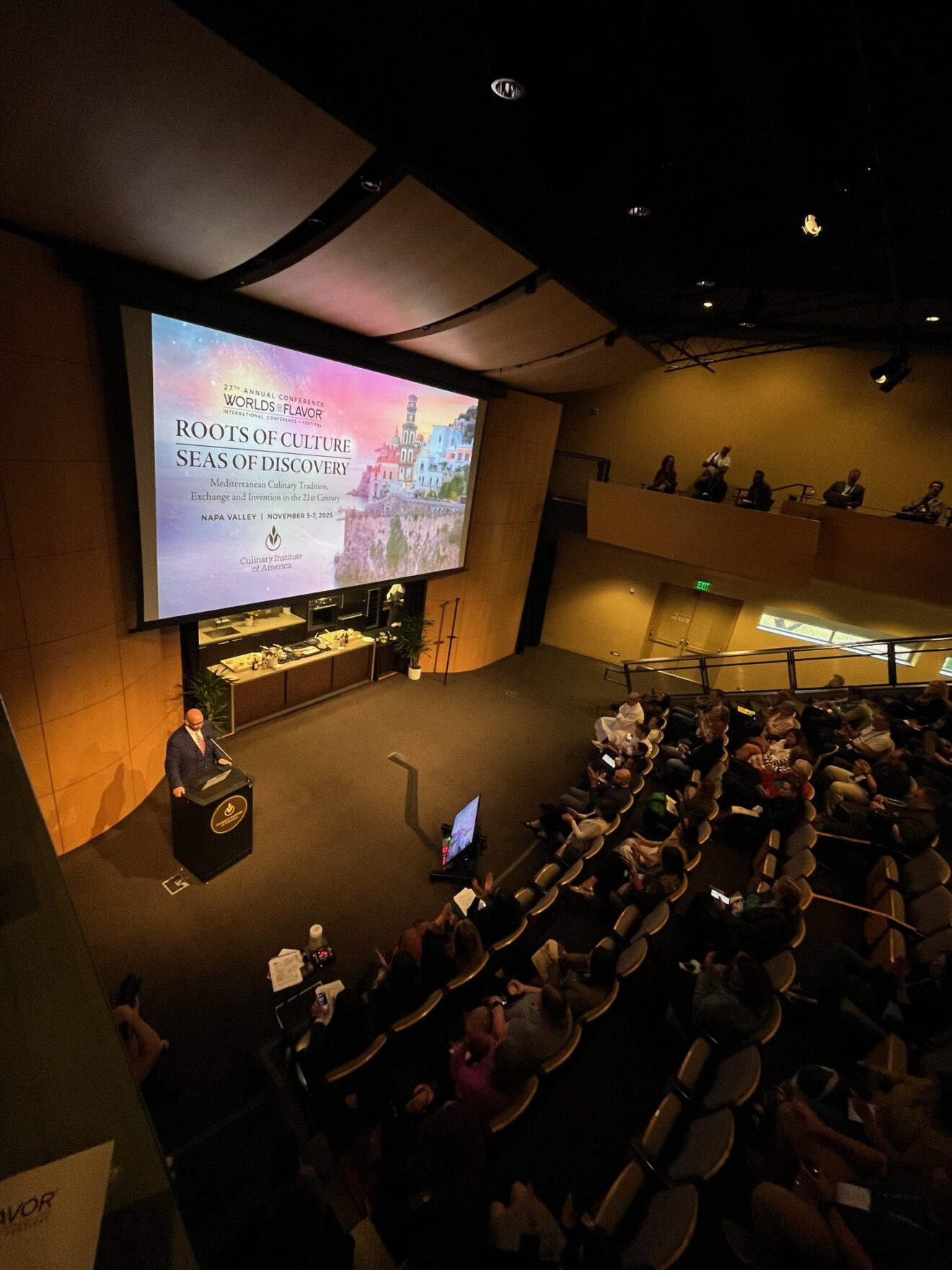
“Where does tradition start?”
That question — posed by Fabrizia Lanza, executive director of the Anna Tasca Lanza Cooking School — echoed through the first day of the 2025 Worlds of Flavor Conference at the Culinary Institute of America at Copia in Napa, Calif. It didn’t fade after the panel ended; it became the quiet refrain of the entire conference.
This year’s theme, “Roots of Culture, Seeds of Discovery: Mediterranean Culinary Tradition, Exchange and Invention in the 21st Century,” explored how heritage and tradition from Mediterranean foodways can inform the future of food. Across three days of sessions, workshops and tastings, one clear theme emerged: Respecting culinary roots does not mean resisting change — it can be a starting point for innovation.
“Since 1998, Worlds of Flavor has been a driving force in introducing global cuisines to American chefs and foodservice operators,” said Jennifer Breckner, director of programs and special projects for The Center for Food & Beverage Leadership at the Culinary Institute of America, who leads the event’s programming. “This program celebrates complexity. We both honor the Mediterranean diet and challenge the idea of a singular Mediterranean identity.”
Breckner emphasized that the conference is not only about showcasing flavors but also about understanding how migration, conflict, religion and trade shape Mediterranean food cultures.
Beyond recipes: Authenticity as lived experience
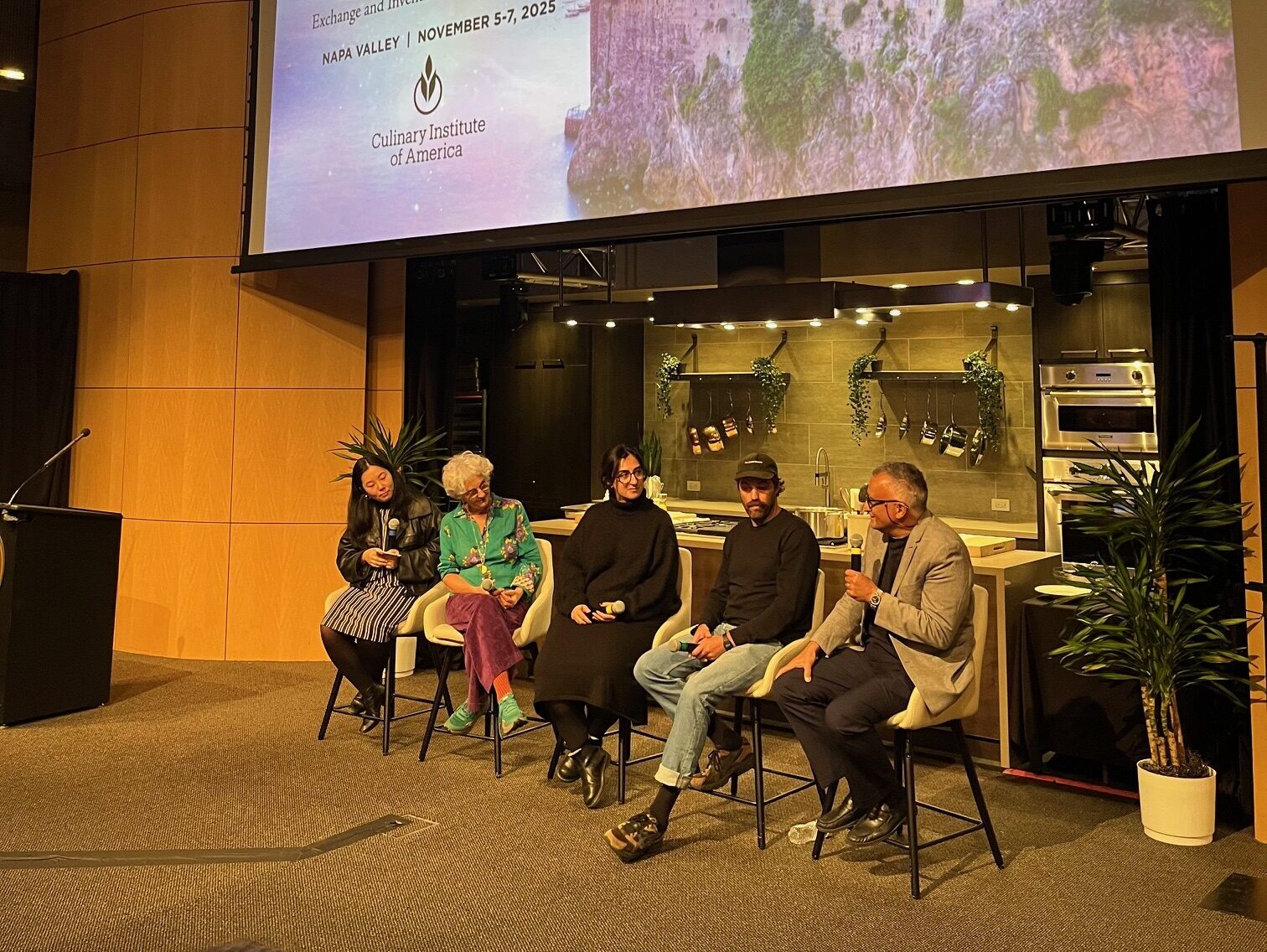
For chefs and culinary experts like Jody Eddy, a Portugal-based cookbook author and recipe developer; Melek Erdal, London-based food writer, cook and storyteller; Nader Mehravari, Persian cookery expert and practitioner, Davis, Calif.; and George McLeod, co-founder and chef, SEM in Lisbon, Portugal, and Lanza, food is a living bridge to culture, history and the land itself. Authenticity, they argued, is less about rigidly following centuries-old recipes and more about connecting deeply to the ingredients, techniques and stories of your own experience.
“Recipes are incredibly volatile,” Lanza said. “An apple one year is [more sour] than the next, water changes, flowers change, weather changes. Authenticity is about what makes sense for you in your place and time.”
Substitutions, the panelists pointed out, aren’t betrayals. They are expressions of creativity shaped by constraints — whether that means mixing orange and lime to mimic Persian ingredients, as Mehrarvari mentioned, or crafting dishes from market leftovers in London community kitchens, as Erdal does.
As for tradition? The panelists suggested it begins in the choices we make with ingredients, the stories we pass on and the ways we adapt customs to our environment.
Sacred kitchens, shared lessons
Jody Eddy’s presentation expanded that idea across centuries and continents. In monasteries, temples, mosques and synagogues in places from Spain to Lebanon to Japan, she found that the most enduring culinary traditions had survived because they were willing to evolve.
For Eddy, who has cooked at Jean-Georges and The Fat Duck and authored award-winning cookbooks, the project didn’t begin with a plan.
“I didn’t have a book in mind,” she told the audience during her presentation on day 1. “I was just really curious about what was happening there.”
It was that curiosity — echoed in stories of monks wearing Yankees caps, investment bankers tending gardens and Michelin-star chefs finding clarity in silence — that eventually shaped Elysian Kitchens, her study of sacred culinary traditions around the world.
What she discovered is that ancient foodways aren’t relics. They’re living systems built on community, adaptability and deep attentiveness to and curiosity in food and place, she said.
The zero-waste way
Historically, sustainability and zero waste have been a way of life for Mediterranean cuisines, long before these concepts became modern trends. Chefs and experts discussed using every by-product from cheese- and yogurt-making and transforming leftover materials into lasting foods — a philosophy reflected in a Turkish kitchen saying that Erdak summed up as: “To not waste is to bring abundance into your kitchen.”
McLeod added that modern sourcing choices carry political and environmental weight. Buying from small farmers, choosing organic products and supporting regenerative systems are forms of activism — each purchase, he noted, is a vote for the food system operators want to see. Limitations breed innovation, he added.
A living, evolving Mediterranean
The event also explored the question of bridging cultural understanding in the US, where Mediterranean cuisine is often reduced to hummus or Italian coastal dishes.
“Everything is useful, even misunderstandings,” Fabrizia Lanza said. True understanding, she suggested, comes from curiosity, dialogue and engaging directly with local food cultures.
There were many other sessions, panels and demos, all rich with takeaways underscoring how global perspectives and traditions can inform local practice.
Mourad Lahlou, chef-owner, Aziza in S.F. and Moro in Napa, Calif., demonstrated making shakshuka, a traditional North African dish now popular globally, emphasizing the importance of maintaining culinary integrity while experimenting with new ingredients. Greek chefs Stavriani Zervakakou, chef and founder of Aspasia Restaurant Mani and Manolis Papoutsakis, chef and co-owner of Pharaoh, showcased the rich tapestry of regional Greek cuisine. Strategies for integrating traditional flavors into modern menus were shared, demonstrating that culinary heritage can be respected and preserved, as well as transformed, an overarching theme throughout.
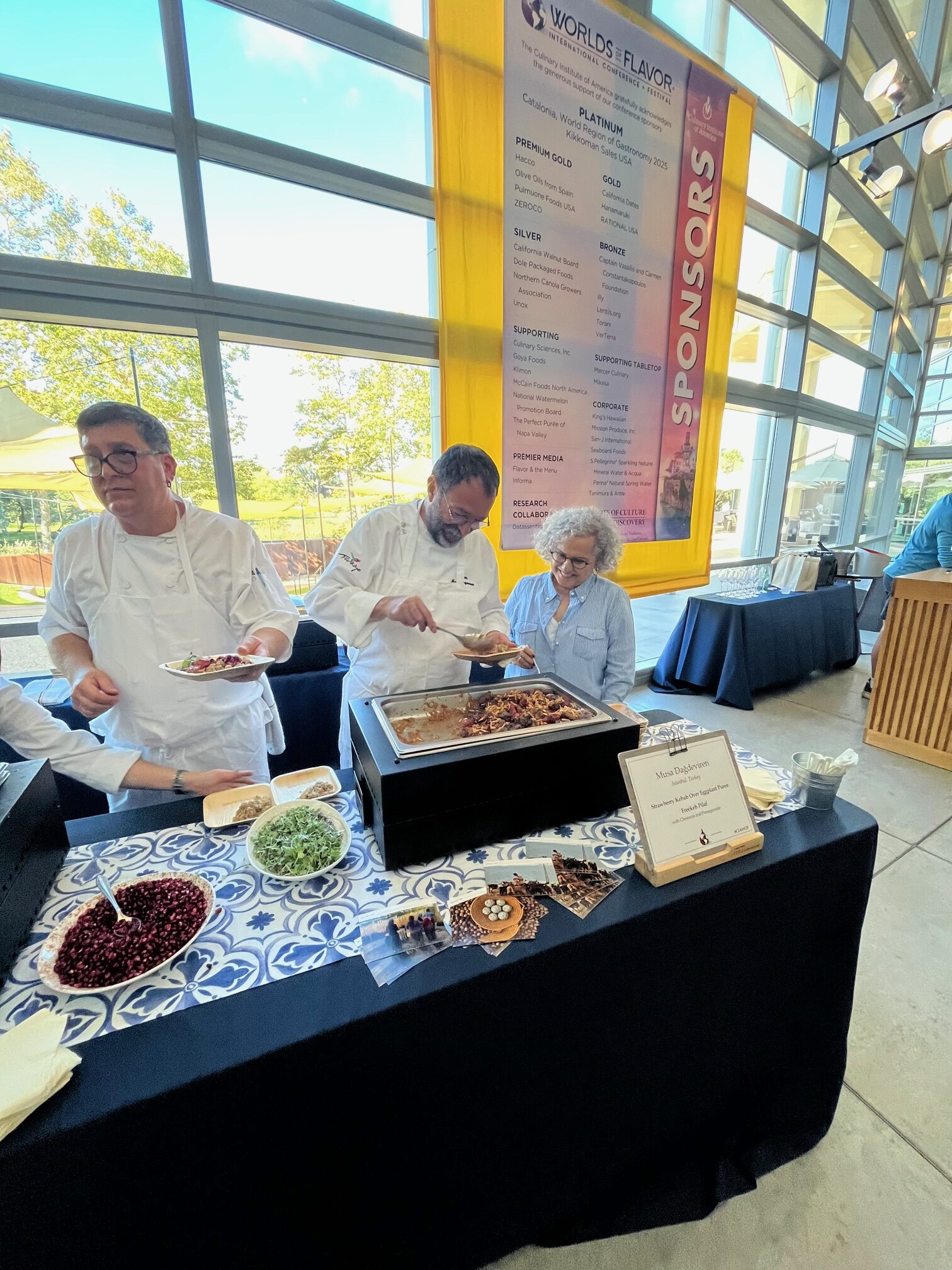
Other exciting demos included chef Edward Lee, who demoed the use of Korean ingredients, like soft tofu, gochujang and kimchi, in dishes like shakshuka and carbonara; Musa Dağdeviren, chef-owner of Çiya Sofrasi in Istanbul, Turkey, who showed the traditional way to make kebabs; and Hoss Zaré, lead operational training executive chef, Bon Appétit at Google in Mountain View, calif., and Fariba Nafissi, chef-owner; ZoZoBaking in Los Angeles, Calif., highlighting the significance of Persian ingredients such as saffron, yogurt and pistachios and their influence in Mediterranean cuisine.
And as Worlds of Flavor painted a vision of Mediterranean cuisine as a dynamic intersection of history, geography, culture and respect, it also showed us that authenticity isn’t a fixed point in time — it is a lived practice rooted in awareness, adaptation and creativity; that sustainability isn’t a trend but a continuation of centuries-old wisdom; and that at the heart of it all, food is a vehicle for connection — across generations, communities and continents.
Related stories:
- Q&A: Unearthing the Mediterranean with Worlds of Flavor
- Food industry event marketing: Why storytelling is your best asset
- Menus of Change Q&A: Building a better food system, one menu at a time
_____________________________________
If you liked this article, sign up to receive one of SmartBrief’s Food & Beverage newsletters. They are among SmartBrief’s more than 250 industry-focused newsletters. And connect with us on our SmartBrief Food & Beverage LinkedIn page for more news, trends and special newsletter editions.