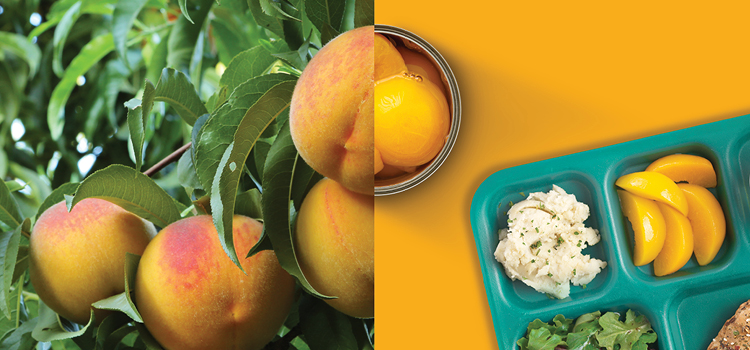
For healthcare foodservice directors and school nutrition leaders, planning menus involves balancing thin margins, ongoing labor shortages and tight federal requirements. In today’s institutional foodservice landscape, true fiscal efficiency and operational value are no longer determined by the lowest bid, and true cost per serving is rarely reflected in the case price.
In reality, prep labor, usable yield, shelf life and waste all enter the equation, shifting the focus of value to consistency and dependability from orchard to tray. In these high-volume kitchens where directors and their staff work to protect both their bottom line and their service, intentional sourcing is proving to be the strongest operational strategy.
That’s why, to build true menu dependability, school nutrition and healthcare foodservice leaders are shifting their focus to ready-to-serve, shelf-stable ingredients such as California Cling Peaches that are backed by farm-to-processor transparency. It is an approach that minimizes back-of-house prep and delivers measurable value and dependability tray after tray.
Here, Tami Iverson, director of marketing communications for Pacific Coast Producers – an agricultural cooperative owned by family farms in Central and Northern California – and Chris Zanobini, executive director of the California Cling Peach Board, explain how forging reliable connections with domestic growers can deliver value, nutritional retention and consistency time after time.
School and healthcare foodservice operators may not always know where the canned fruit they purchase was grown. What should buyers know about the differences between domestically sourced and imported peaches, and why does country of origin matter?

Zanobini: Most buyers never look at where their canned fruit was grown, and I understand why. Institutional orders move fast, and the product description and case price usually drive the decision. But country of origin is right there on the label, and it’s worth a look. California Cling Peaches are grown by family farmers in the Central Valley, many of them working land their families have farmed for generations.
Cling peaches are a different fruit from the fresh peaches in the produce aisle. They’re grown specifically for canning, so they hold their shape, color and texture, and with orchards located near the canneries, they’re canned within hours of harvest. When you choose California-grown, you know who grew your fruit and the standards it was grown under. For schools, origin also matters for Buy American compliance, so it’s worth checking before the bid goes out.
What role does product sourcing play in traceability, quality and food safety for institutional foodservice operators?

Iverson: Pacific Coast Producers is a California-based, grower-owned cooperative supported by generations of farming families. With orchards located near our canneries, we maintain a close connection between where our fruit is grown and where it is packed. For foodservice operators, that means confidence in the quality, care and accountability behind every can. That connection also supports our commitment to food safety. From responsible agricultural practices and raw-product protection to transportation and processing, food safety is considered throughout the journey from the farm to the finished product. Our long-standing grower relationships help us deliver consistent quality and dependable products season after season, backed by the commitment of the growers who own our cooperative.
Institutional menus in schools and healthcare facilities are planned months in advance. How does a shelf-stable product like California Cling Peaches help operators plan with confidence?
Iverson: Schools and hospitals plan their menus months in advance, so they need ingredients they know will be there when they need them. That’s one of the real advantages of canned California peaches. Our harvest typically starts around July 4 and runs through September. We pack that crop during the harvest season and then supply customers from that inventory throughout the year.
And with a three-year shelf life, operators and distributors have tremendous flexibility. They can plan ahead, keep product on hand and know they have a dependable ingredient ready when they need it. Just as importantly, canned peaches provide the consistent quality and performance operators need from one menu cycle to the next. If I could give operators one piece of advice, it would be to specify ‘Product of USA’ in their bid requirements. Putting this in the specification helps ensure that what you planned for is what ultimately arrives at your operation.
When procurement budgets are tight, buyers often focus strictly on case price. What other factors should operators consider when comparing the cost and value of California Cling Peaches with imported alternatives?
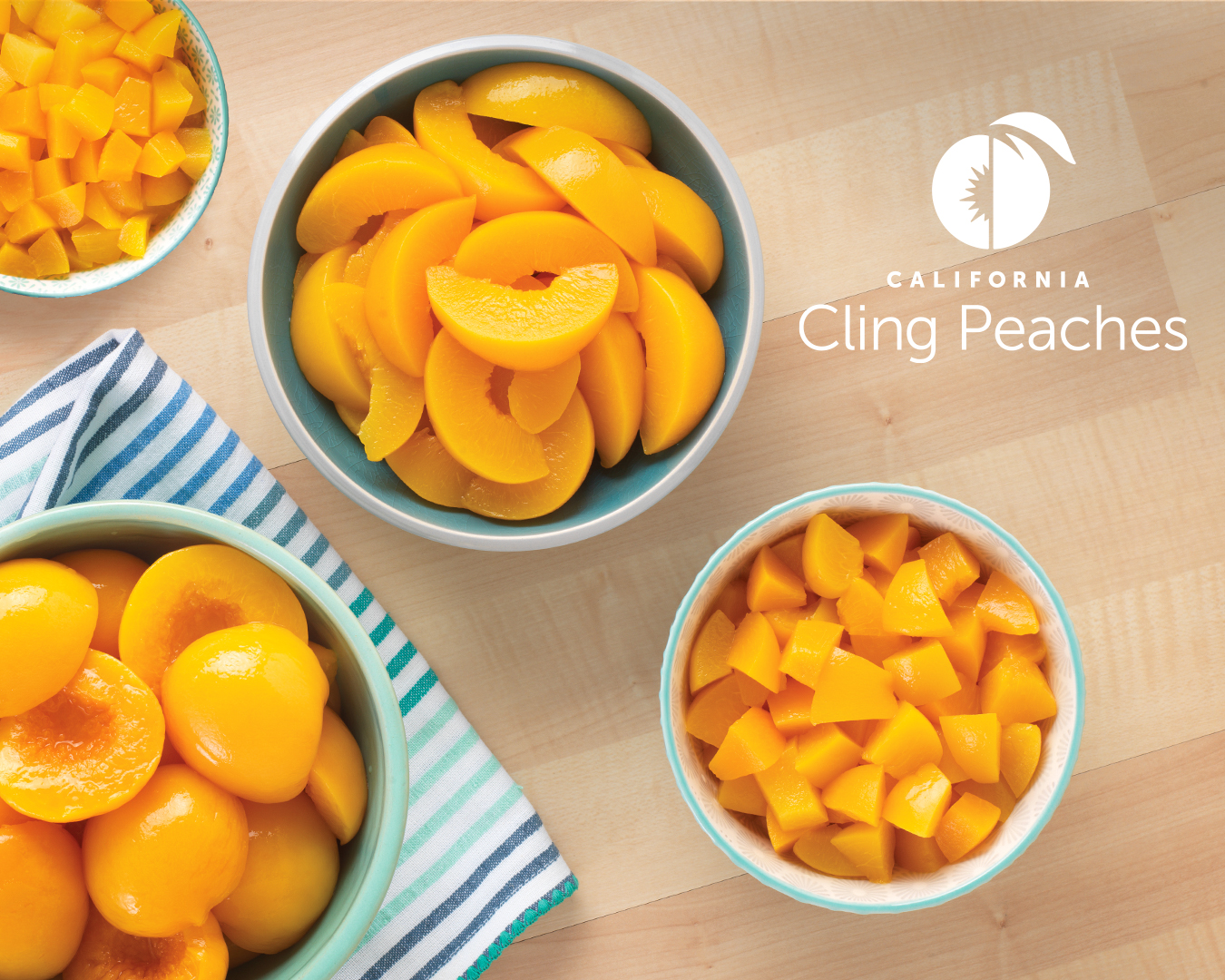
Iverson: Case price matters, but I think the better measure is the cost and value per serving. Our California Cling Peaches come ready to serve, so there’s no peeling, pitting, cutting or trimming waste. Our typical No. 10 can provides approximately 24 half-cup servings as packaged, depending on the specific product.
There’s also value in dependable availability, consistent quality and food safety. And with USA-grown fruit, you’re supporting a grower-owned cooperative representing hundreds of family farms. When you put all of that together, a lower case price doesn’t necessarily mean a lower cost on the tray.
Efficiency remains a top concern across institutional kitchens. What operational advantages do ready-to-serve California Cling Peaches deliver during meal prep?
Iverson: For operators, one of the biggest advantages is predictability. Our No. 10 canned peaches are shelf-stable and stored at ambient temperatures, so they’re easy to keep on hand without taking up valuable cooler space. They also deliver consistent taste, texture, color and performance from can to can, which is important when you’re producing meals at scale. And they’re incredibly versatile. The same product can move from a simple fruit serving to breakfast parfaits, smoothies, salads, salsas or desserts. That gives operators one dependable ingredient they can use in a lot of different ways across the menu.
How does a single SKU of California Cling Peaches packed in juice help operators meet specific requirements, like the USDA 1/2-cup of fruit or soft and easy-to-chew diets, across dayparts?
 Iverson: One SKU can work across a surprising number of needs. In schools, a ½-cup serving of canned fruit in juice can help meet USDA fruit requirements, and peaches can move across breakfast, lunch and snack applications rather than being limited to a side on the tray. In healthcare, that same versatility is valuable. PCP has been developing peach applications for patient dining, retail, catering and community-health programs, including parfaits, smoothies, oatmeal, salads, sauces and other recipes. All of these recipes and toolkits can be found on our website. So instead of thinking about peaches as simply a side, one product can help operators meet nutrition needs while giving them flexibility across multiple menu items.
School nutrition directors navigate strict Buy American provisions, while healthcare leaders are responding to the “food as medicine” movement. How can California Cling Peaches help institutional operators address these priorities?
Zanobini: Those two priorities line up better than people might expect. Schools are required to buy domestic food whenever they practically can under the U.S. Department of Agriculture’s updated Buy American rules, which limit non-domestic purchases to 10 percent of commercial food costs before dropping to 5 percent by the 2031-32 school year.2 California Cling Peaches are grown and packed here, so they meet that requirement.
On the healthcare side, food as medicine comes down to getting good nutrition to patients in a form they’ll actually eat. Peaches do that well. They’re soft, easy to eat and familiar to just about everyone, from young patients to seniors. Peaches packed in juice have no added sugar, and a study by Oregon State University published in the Journal of the Science of Food and Agriculture found that drained canned cling peaches had higher measured vitamin C and folate levels and greater antioxidant activity than fresh freestone peaches.1 When patients enjoy what’s on the tray, the nutrition actually reaches them.
What’s the simplest way for operators to make sure they’re getting California-grown peaches?
Zanobini: Ask for them. Tell your distributor you want California Cling Peaches, and write ‘Product of USA’ into your bid specs. Then take a quick look at the label when the cases arrive. It’s a small step, and it means the fruit on your trays was grown by American farm families.
—————————————————————
References:
1 U.S. Department of Agriculture, Food and Nutrition Service. 2024. “Child Nutrition Programs: Revisions to Evidence-Based Nutrition Standards and Buy American Provisions.” Federal Register, Rule 89 FR 35510. https://www.federalregister.gov
2 Durst, Robert W. 2013. “Nutritional Content of Fresh and Canned Peaches.” Journal of the Science of Food and Agriculture 93, no. 3: 593-603. https://doi.org/10.1002/jsfa.5849
Recent related stories:
- California Cling Peaches answer the call for versatile, clean, locally sourced foodservice ingredients
- Q&A: Going deeper into East and Southeast Asia through CIA’s Worlds of Flavor
- Why family mealtime may be the most important thing on your to-do list
_____________________________________
If you liked this article, sign up to receive one of SmartBrief’s Food & Beverage newsletters. They are among SmartBrief’s more than 250 industry-focused newsletters.
Formed in 1996, the California Cling Peach Board supports the state’s growers through research, education and outreach, with a focus on promoting affordable, nutrient-rich fruit. California Cling Peaches are grown in the U.S., picked at peak ripeness and packed within hours to lock in vitamins, minerals and flavor. Available year-round in cans, jars, and single-serve cups with consistent quality and portion control, they’re a practical, healthful choice for meal planning across healthcare, school and community settings.